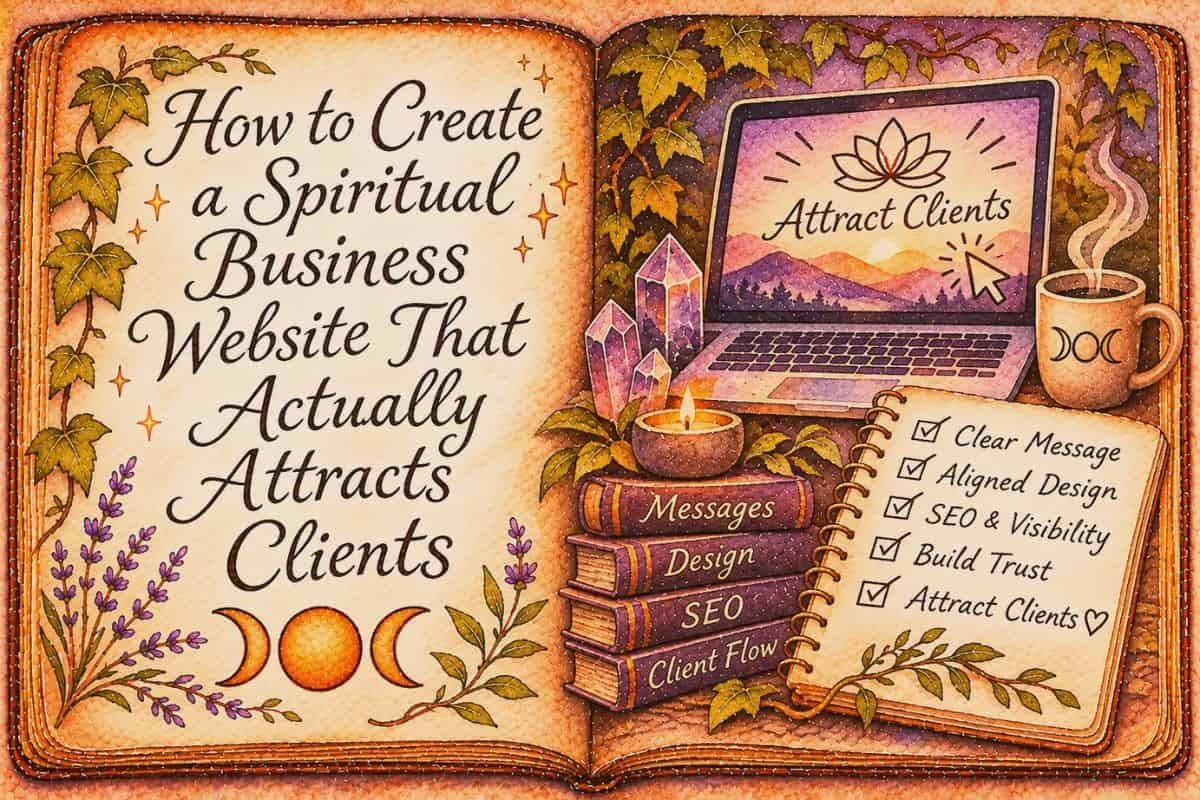
A spiritual business website attracts clients when it does two things at once: it feels like your work, and it helps people quickly understand what you offer, trust you, and know what to do next. Beauty and atmosphere matter, but clarity is what turns a visitor into a client. That is where many spiritual and holistic websites become stuck. They can be beautiful, atmospheric and deeply meaningful, yet the person landing on the page is still left wondering what is actually being offered, whether it is right for them, and how to begin. The strongest websites create connection and clarity at the same time. They let your personality, values and spiritual language shine without asking the visitor to decode the business behind them.
What does a spiritual business website actually need to do?
Your website has several jobs, and it helps to think about them before choosing colours, fonts or imagery. It needs to:
- Introduce your work
- Help the right person recognise themselves
- Explain your services clearly enough for someone to decide
- Build trust
- Guide the visitor towards a natural next step
If you also want to be found through Google and AI search, your site needs to make sense to search engines too. That does not mean writing in stiff SEO language. It means being clear enough that both people and search engines understand what your business is about.
Start with the person you want to reach
Before you think about design, think about the person arriving on your site. What is she looking for? What is she struggling to make sense of? What does she need to understand before she feels ready to stay, explore or contact you? This matters even more in spiritual and holistic work, because the business itself is often layered. You may combine coaching, energy work, healing, ritual, embodiment or several modalities at once. Your website does not need to explain every layer straight away. It needs to give your visitor enough orientation to keep moving.
Your homepage should make sense quickly
The top of your homepage should answer a few questions within seconds:
- Who do you help?
- What do you help them with?
- What do you offer?
- What should they do next?
This is one of the biggest places spiritual websites lose people. A poetic headline may sound beautiful, but if the visitor cannot tell what the business actually does, the message becomes harder to trust. You can absolutely use soulful language. Just anchor it with something clear. For example, “Bespoke WordPress websites for spiritual entrepreneurs and holistic practitioners” gives immediate orientation. Once the visitor understands that, your more expressive words can deepen the experience rather than carrying the whole message.
Let your website reflect your work without hiding it
There is a difference between mystery and confusion. Your brand can feel atmospheric, earthy, witchy, elegant or deeply personal, but a visitor should still know what you do.
A helpful approach is to use two layers:
- First, say what the service is in clear language
- Then, explain what makes your approach different
For example:
Website Design for Spiritual Entrepreneurs
Thoughtful, bespoke WordPress websites created to hold the depth of your work without losing clarity.
The first line helps someone understand. The second helps them connect.
Keep your website structure simple
Most spiritual businesses do not need dozens of pages. A clear structure is usually far more effective than a large website with too many competing routes. A solid starting point might include:
- Homepage
- About page
- Services or Work With Me page
- Individual service pages, where needed
- Testimonials
- Blog or resources
- Contact or booking
- Legal pages
If you offer several distinct services, separate pages are often useful. A coaching programme, a Reiki session and a digital product may all need very different information. Giving each one its own space helps your visitor understand it without feeling overwhelmed, and helps search engines understand each page too.
For a full checklist, see what a holistic therapist website should include.
Your About page should still be about the reader
Your story matters, especially when personal experience, philosophy and values shape how you work. Your About page should not become a complete autobiography, though. The visitor is usually looking for a few things:
- Why do you do this work?
- What shaped your approach?
- What experience do you bring?
- What do you believe?
- Why might you be the right person for them?
Share enough of yourself to create connection, but keep bringing the story back to what it means for the person reading. My guide on how to write an About page that connects walks you through it.
Make your services easy to understand
Spiritual and holistic work can be hard to describe, because the experience may be intuitive, subtle or difficult to reduce to a few bullet points. That is exactly why your service pages need structure. A good service page helps someone understand:
- Who the offer is for
- What they may be experiencing now
- What they want instead
- How the service can help
- What happens when they work with you
- What is included
- How long it lasts
- What it costs
- How to begin
That does not make the work mechanical. It simply gives your visitor enough information to make an informed decision.
Talk about outcomes, not only methods
Your clients often care less about the name of a modality than you do. That does not mean the method is unimportant. It means the outcome needs to come first. Instead of leading with a list of techniques, begin with what someone may experience as a result of the work. Then explain how you work, once they understand why it matters.
For example, “This session combines intuitive energy healing, somatic work and breathwork” may be accurate. “This work is designed to help you recognise the patterns you have been carrying, reconnect with your own voice and feel clearer about what belongs to you now” gives the visitor something more immediate to connect with. The method explains the process. The outcome explains why they might care.
Use testimonials to show what changes
Testimonials are one of the strongest ways to build trust, because they let someone see your work through another person’s experience.
The most useful testimonials are specific. They show:
- How someone felt before
- What shifted
- What they noticed afterwards
- What they valued about the experience
A short “this was amazing” is lovely to receive, but it does not tell a new visitor very much. A testimonial that explains what changed gives them something to recognise and relate to.
Make the next step obvious
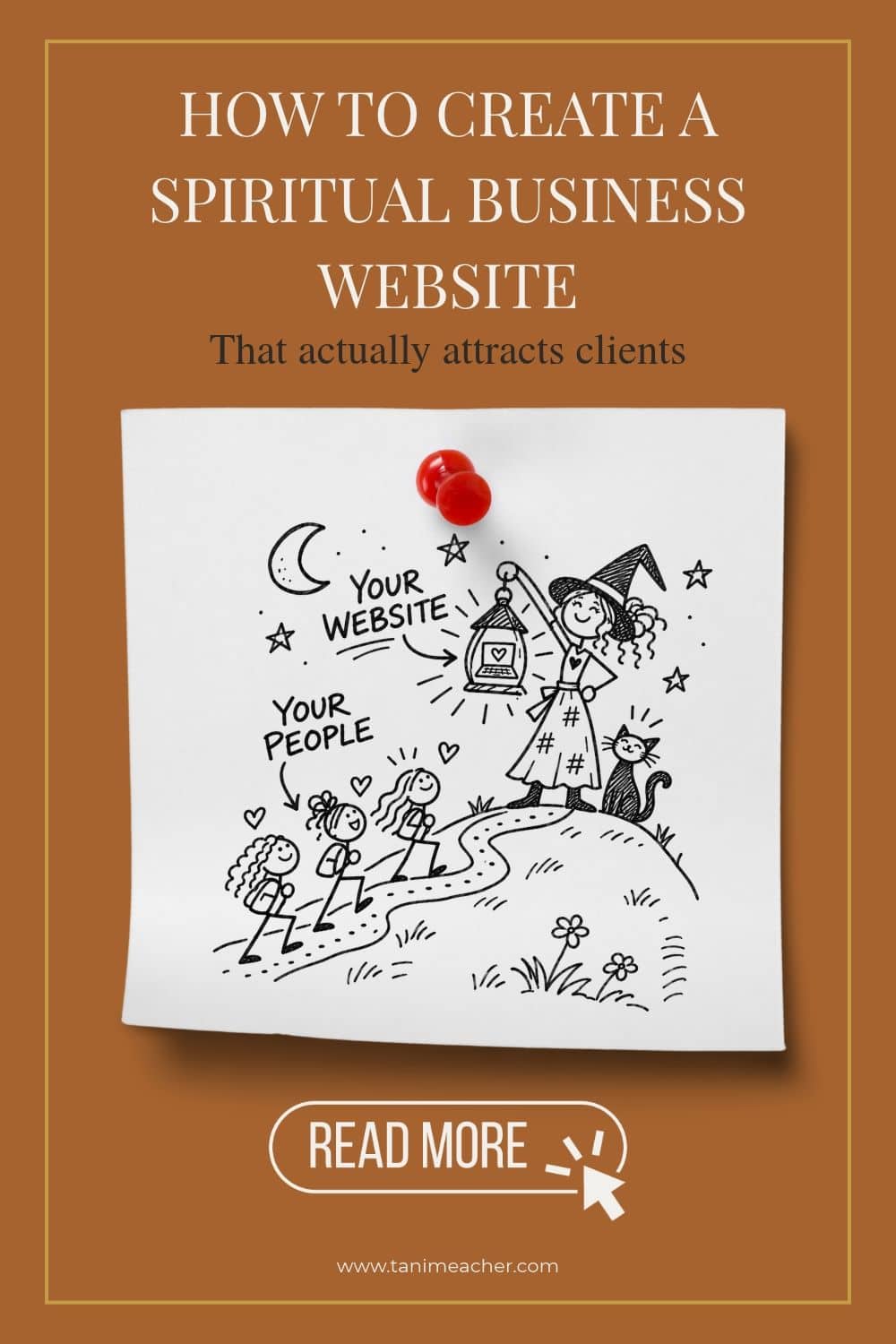
Every important page should lead somewhere. A visitor should not reach the bottom of a page and have to work out what to do next. Depending on the page, the next step might be to:
- Book a session
- Arrange a discovery call
- Explore a service
- Join your mailing list
- Read another article
- Get in touch
Not every page has to make a hard sale, but every page should offer direction. If people visit but rarely get in touch, my post on why you may not be getting enquiries from your website goes deeper.
Do not rely on Instagram to do your website’s job
Social media is valuable for visibility, connection and relationship-building, but it is not a replacement for a website. Your social posts disappear quickly. Your website gives your work a permanent home. It can be found on Google, hold detailed information, collect email addresses, explain your offers and answer common questions, without you repeating the same information in messages.
Your website and social media should support each other. Read more in do I need a website if I already have Instagram?
Build for mobile from the beginning
Many visitors will see your website on a phone long before they see it on a computer, so mobile design cannot be an afterthought. Check whether:
- Text is easy to read
- Buttons are easy to tap
- The menu makes sense
- Images load quickly
- Forms work properly
A beautiful desktop site that becomes awkward on a phone is not a finished website.
Use imagery that supports the atmosphere of your work
The imagery on a spiritual website does a lot of emotional work. It helps someone feel the tone of your brand before they have read very much. Where possible, use images connected to your real business: your space, your tools, your hands, your rituals, your surroundings and your personality. These almost always create more connection than generic stock photographs. The images do not need to be highly polished. They need to feel intentional. For help with colours and fonts too, see how to choose website colours and fonts for a spiritual business.
Your words should sound like you and still be searchable
Many spiritual entrepreneurs worry that SEO means flattening their voice or filling the website with awkward keywords. It does not. You can write in your own language while still using the words people actually search for. Clear, searchable phrases simply sit alongside your more expressive wording, for example:
- Reiki practitioner Hampshire
- website designer for healers
- holistic therapist
- spiritual business coach
These help Google understand the service. Your more distinctive language then explains what makes your work different. Clarity does not dilute your message. It helps the right people find it.
Build trust before someone contacts you
Most people do not land on a website and immediately get in touch. They read, browse, compare and often return several times before taking the next step. Your website needs to support that quieter decision-making.
Trust comes from many small signals working together:
- Clear language
- Professional design
- Testimonials and qualifications
- A visible face
- Consistent branding
- Useful content
- Clear contact information
- Transparent pricing, where appropriate
- A secure website
- A good mobile experience
You do not need to keep saying “trust me”. The website itself should create that feeling.
Professional does not mean corporate
A professional spiritual website does not need to look sterile or conventional. It simply needs to feel considered. The navigation should make sense. The design should be consistent. The text should be readable. The offers should be understandable. The whole experience should feel current and cared for. Your personality can still be everywhere. Professionalism is not the absence of personality. It is the presence of clarity.
Avoid trying to say everything at once
One of the most common problems on spiritual websites is overloading the homepage with every offer, qualification, story and message. Your homepage does not need to carry the whole business. Your About page does not need every chapter of your life. Your Services page does not need every detail of every offer. Think of your website as a conversation. You do not tell someone everything in the opening sentence. You give them enough to understand where they are, then guide them deeper.
A beautiful website is not enough
A website can be visually stunning and still not bring in enquiries. It can be hard to navigate, unclear, hard to find on Google or disconnected from how your business has grown. Design matters, but it has to support communication. The most effective websites bring visual identity, words, structure and the visitor’s journey together. That is when a website starts to feel like part of your business rather than a digital brochure.
Create a website that makes it easier to choose you
Your website should not require someone to decode your work. It should help them understand it. It should give them somewhere to explore, make your expertise visible, and let the right person reach a point where contacting you feels like a natural next step. You do not need to remove the soul from your business to make your website clearer. You simply need to give that soul structure.
Frequently Asked Questions
Why is my spiritual website not getting clients? Usually because visitors cannot quickly tell what you offer, the next step is unclear, or the website is not being found on Google. Clearer headlines, simpler service pages and obvious booking buttons often make a real difference.
How do I make my spiritual website feel like me? Use your own photographs, colours and words, and let your personality show in how you write. Pair that atmosphere with clear explanations of what you offer, so visitors feel connected and understood.
What is the best platform for a spiritual business website? Wix and Squarespace are easy to start with, while WordPress offers more ownership and room to grow. My Wix vs Squarespace vs WordPress comparison explains the differences.
How much does a spiritual business website cost? A DIY website usually costs around £100 to £400 a year, while a professionally built website typically ranges from about £1,500 to £3,000. See my guide to website costs in the UK.
Would you like a website that feels like your work and brings in the right clients?
I create bespoke WordPress websites for spiritual entrepreneurs, holistic practitioners, healers and coaches, designed to hold the depth of your work without losing clarity.