
In the UK in 2026, a small business website typically costs from around £100 to £400 a year if you build it yourself, £1,500 to £3,000 for most professional freelance builds, and £3,000 to £10,000 or more through an agency. The price depends far less on the number of pages than on how much strategy, copy, branding and support is included.
If you have ever asked how much a professional website costs, you will probably have discovered very quickly that there is no single answer. One designer may quote a few hundred pounds, another several thousand, and an agency may come back with a figure that feels completely out of reach.
That does not necessarily mean anyone is overcharging. It usually means they are not offering the same thing.
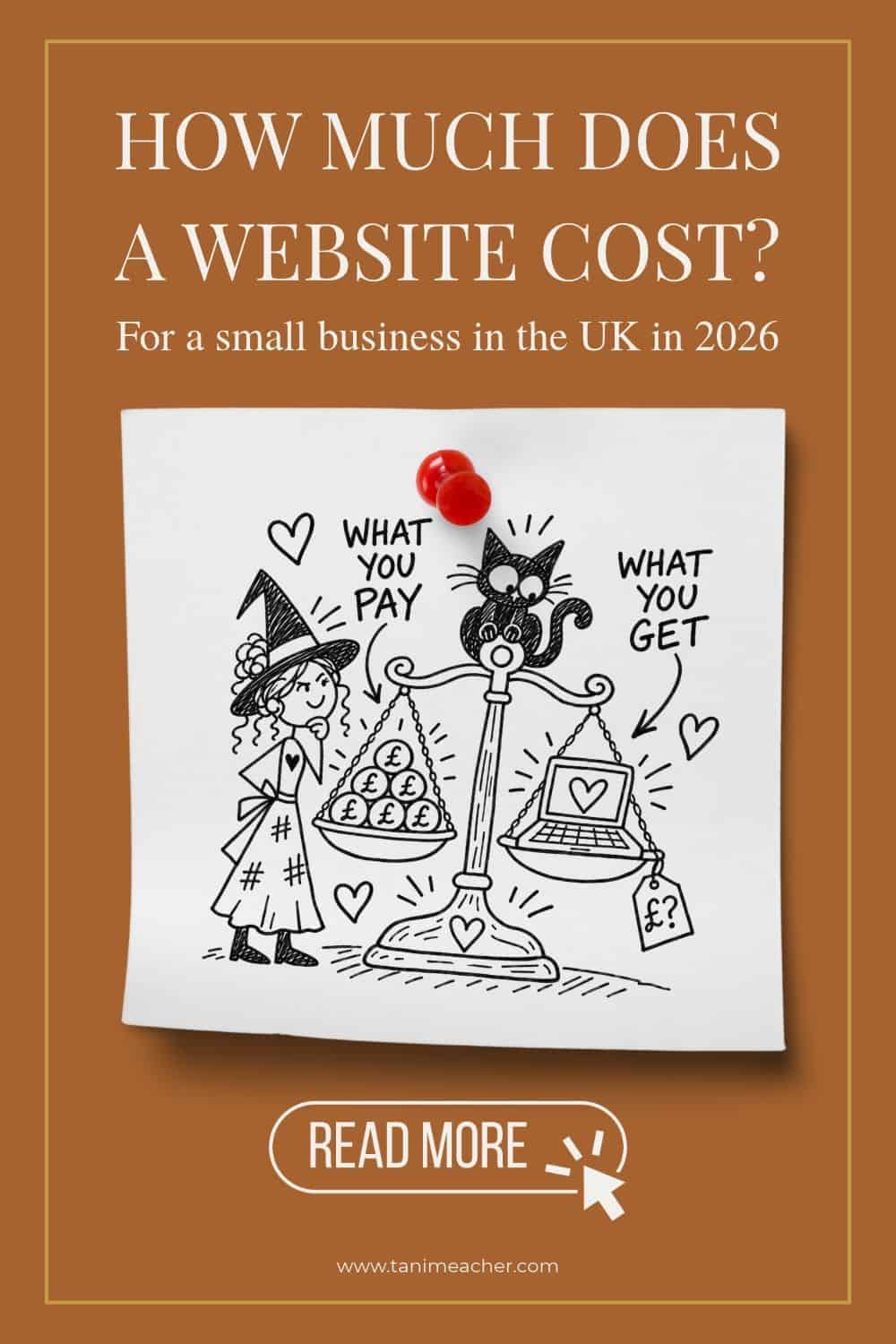
The real question is not simply, “How much does a website cost?” It is, “What am I actually getting for that investment?”
UK website costs at a glance
DIY website
- Around £100 to £400 a year
- Plus your own time to build and maintain it
- Best for testing an idea or a very simple presence
Freelance web designer
- Around £500 to £5,000 or more
- Most professional projects sit between about £1,500 and £3,000
- Best for small service businesses that want personal, tailored support
Web design agency
- Around £3,000 to £10,000 or more
- Best for larger organisations with complex needs
Ongoing running costs
- Several hundred pounds a year is common
- Covers hosting, domain, licences and maintenance
How much should a spiritual or holistic business spend on a website?
There is no magic figure. A newer practitioner who needs a clear five-page website has very different needs from an established coach with programmes, workshops, a content library and digital products.
Rather than deciding how much you “should” spend based on what other people are doing, begin with what your website needs to do. Ask yourself:
- Does it simply need to establish credibility?
- Does it need to generate enquiries?
- Does it need to help people find me on Google?
- Does it need to sell?
- Does it need to reduce how much I explain manually?
- Does it need to hold several parts of my business?
Once you know what your website is responsible for, the investment becomes much easier to judge.
If you would like to see what a bespoke website for a spiritual or holistic business includes, you can explore my website design services.
Why do website prices vary so much?
Two websites can both have five pages and still need completely different amounts of work.
One might use an existing template, supplied copy and ready-made photography. Another might involve a bespoke visual direction, help shaping the messaging, SEO research, custom layouts, booking integrations, email marketing connections and several rounds of refinement.
From the outside, they may both look like five-page websites. Behind the scenes, they are very different projects.
That is why comparing quotes purely by page count can be misleading. What matters is the depth of work behind those pages and how much support is included.
How much does a DIY website cost?
Building your own website is usually the least expensive option financially. Wix and Squarespace charge ongoing subscription fees, while WordPress has costs for hosting, themes and sometimes paid plugins.
Basic DIY website costs typically run from roughly £100 to £400 a year, before you account for your own time. If you are weighing up the platforms, my comparison of Wix vs Squarespace vs WordPress may help.
DIY can be an excellent option when you are starting out.
The cost people often forget is time. You are not only designing pages. You are learning the platform, deciding on the structure, writing the copy, choosing images, working out mobile layouts, setting up forms and troubleshooting when something does not behave.
If you enjoy that, it may be a perfectly sensible use of your time. If you spend three months avoiding your website because every small change becomes another evening of tutorials, the calculation looks rather different.
How much does a freelance web designer cost in the UK?
Freelance pricing varies enormously because freelancers themselves vary enormously.
Someone who mainly customises templates may charge considerably less than a designer who builds a strategic website around your brand, audience, content and client journey.
Professional freelance small-business websites range from around £500 at the lower end to £5,000 or more, with many standard projects sitting somewhere between about £1,500 and £3,000.
That range is large because “freelance website design” is not one standard product. Always look at what the quote actually includes.
How much does a web design agency cost?
Agencies generally cost more because you may be paying for several specialists rather than one person: a strategist, designer, developer, copywriter, SEO specialist and project manager.
For a fairly straightforward small-business website, agency pricing commonly starts at around £3,000 to £10,000, with larger bespoke projects costing significantly more.
For a small coaching, healing or holistic business, that level of infrastructure may be unnecessary. Equally, a growing organisation with complex needs may genuinely benefit from it.
The size of the supplier should match the needs of the project.
What actually affects the cost of a website?
The number of pages matters, but it is only one part of the price. The biggest factors are:
- Complexity. A simple website with Home, About, Services and Contact costs less than one with several service pathways, online booking, digital products or a membership area.
- Copy. Supplying finished words is very different from working with someone who helps shape your messaging and explain a multi-layered business clearly.
- Branding. If your colours, fonts and imagery are already defined, your designer has a direction to work from. If not, that work has to happen somewhere in the project.
- Features. Bookings, payments, email sign-ups and integrations all add time.
- Support. Training, revisions and aftercare after launch vary widely between quotes.
Is website copy usually included?
Not always, and this is worth checking carefully.
Some web designers expect you to provide every word before they begin. Others include copywriting or copy support as part of the package. That difference can dramatically affect both the cost and the finished result.
A website can be beautifully designed but still struggle if the words are unclear. Equally, strong copy can lose its impact if the structure makes it hard to follow. For service businesses in particular, design and copy need to work together.
When comparing quotes, ask whether you are responsible for finished copy or whether messaging support is included. If you would like help finding the right words, Word Alchemy is a gentle place to start.
What about branding?
Again, do not assume it is included. Website design and brand identity are connected, but they are not the same service.
If you already have a logo, colour palette, typography and photography that genuinely represent your business, your designer can work within that identity.
If your branding is inconsistent or no longer reflects your business, the website project may reveal those gaps very quickly. That does not always mean an expensive full rebrand. Sometimes what is needed is simply a clearer visual direction before the build begins, which is what Brand Alchemy is designed for.
Does SEO cost extra?
It depends what someone means by “SEO included”.
There is a difference between building a website with good SEO foundations and providing an ongoing search strategy.
A well-built website should include sensible page structure, mobile responsiveness, clear headings, good URLs, metadata, image optimisation and a structure search engines can understand.
More advanced SEO may include keyword research, competitor analysis, content strategy, local SEO, structured data and ongoing monitoring.
Do not assume a website will appear on page one of Google simply because “SEO” appears on the proposal. Ask what is actually being done.
What other costs should I budget for?
The initial build is not always the full cost of owning a website. Depending on your platform, you may also need to budget for:
- Domain name
- Hosting
- Business email
- Premium plugins or theme licences
- Booking software
- Email marketing software
- Payment processing fees
- Ongoing maintenance
Some providers bundle several of these together. Others charge separately. Ongoing costs can come to several hundred pounds a year, which is why the cheapest initial quote is not always the cheapest long-term option.
Ask what happens after launch. My Aftercare and Support page explains how I look after websites once they are live.
What should a professional website quote include?
A professional quote should make it easy to understand what you are buying. Look for:
- The approximate number and type of pages
- What design work is included
- Whether copy is supplied by you or supported
- How mobile layouts are handled
- Which integrations are included
- How many revisions are allowed
- What happens after launch
- Who owns the website, hosting and domain
- Whether you can make everyday changes yourself
If important information is vague before the project begins, it rarely becomes clearer once it is underway.
Why can two designers quote completely different prices?
Because you may be buying very different levels of involvement.
One designer might take the content you provide and place it into an existing layout.
Another may spend time understanding your audience, reorganising your services, developing the visual direction, improving the wording, creating custom layouts, setting up SEO foundations and thinking through your whole client journey.
Neither approach is automatically wrong. You simply need to know which one you are paying for.
A lower-cost option may be exactly right if everything else is already established. A more involved process becomes valuable when your website needs to help you clarify your business as well as present it.
Is a cheaper website always a false economy?
No. Sometimes inexpensive is exactly what makes sense.
If you are testing a new idea, have a very limited budget or only need a simple online presence, spending thousands may not be sensible.
The difficulty comes when you choose the cheapest option while expecting the results of a much more involved project. A £400 template site and a £3,000 bespoke website are not usually solving the same problem.
Be realistic about what you need now. You can always evolve later.
When is it worth investing in a bespoke website?
A bespoke website tends to make more sense once your business is established enough that you know what needs to be communicated. It may be time if:
- You have outgrown your DIY website
- Your offers have become more complex
- You want to be found more easily on Google
- You are tired of piecing together different platforms and links
- Your website no longer matches the quality of your work
At that point, you are not only paying for pages. You are paying for clarity, structure, design decisions, technical setup and someone else’s expertise.
If some of that sounds familiar, these 10 signs you’ve outgrown your DIY website may help you decide.
How do you know whether a website quote is good value?
Do not judge a quote only by the final number. Instead, look at:
- What it takes off your plate
- What expertise is included
- Whether the finished website will be easy to maintain
- Whether it has room to grow
- Whether you understand what happens before, during and after the project
- The designer’s existing work
The lowest quote is not automatically the best value, and neither is the most expensive. Good value means the scope and quality are right for the business you actually have.
A website is not just a design expense
The most useful way to think about website cost is not simply as the price of making something look attractive online.
A good website becomes part of the foundations of your business. It introduces you when you are not there. It answers questions. It helps people find you. It builds trust, collects enquiries and guides people towards your offers. It can keep doing those things for years.
That does not mean you need the most expensive website you can afford. It means you should understand what you are paying for, and choose the level of website that supports where your business is now while leaving room for where it is going next.
Frequently Asked Questions
How much does a basic website cost in the UK? A basic DIY website usually costs around £100 to £400 a year in platform and hosting fees. A basic professionally built website from a freelancer typically starts from around £500.
How much does a 5-page website cost in the UK? It depends on how much design, copy and strategy is included. A template-based five-page site may cost a few hundred pounds, while a bespoke five-page site with copy support and branding is more likely to cost between £1,500 and £3,000.
Is it cheaper to build my own website? In money, usually yes. In time, often not. Factor in the hours spent learning, building, writing and fixing, and whether that time would be better spent with clients.
What are the ongoing costs of a website? Expect to pay for your domain, hosting and any paid software each year, plus maintenance if someone looks after updates and security for you. This often comes to several hundred pounds a year.
Can I pay for a website in instalments? Many freelance designers offer payment plans, so it is always worth asking. I offer monthly payment options on my website design packages.