
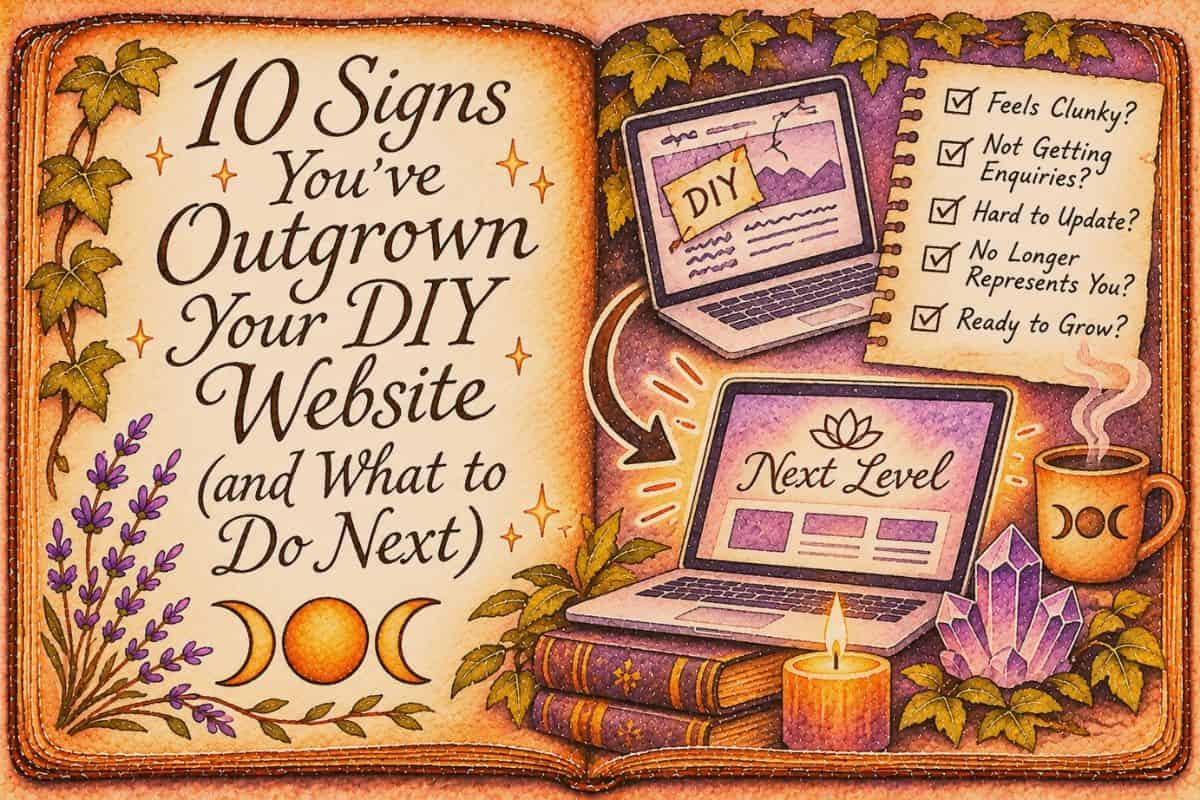
You have probably outgrown your DIY website if you feel embarrassed to share it, your offers have changed but the website hasn’t, visitors struggle to understand what you do, or you keep putting off updates because it all feels too tangled. If several of the signs below sound familiar, it may be time for a refresh or a professional redesign.
There is nothing wrong with starting with a DIY website. For many businesses, it is exactly the right place to begin. You need somewhere to send people, somewhere to explain what you do, and something that gets you visible without a big investment before your business has found its feet. The problem comes later. Your business evolves, your offers become clearer, your audience changes, your confidence grows, and suddenly the website you built at the beginning no longer reflects the business you run now. That does not mean the original website was a mistake. It simply means you have moved beyond it. So how do you know when that point has arrived?
1. You feel embarrassed to send people to your website
This is often one of the clearest signs. You meet someone who could become a client, collaborator or referral partner, and instead of confidently saying “have a look at my website”, you find yourself apologising first. It’s a bit out of date. I need to redo it. Ignore that page. That hesitation tells you something. Your website should support your confidence in your business, not undermine it. If you are reluctant to share it, the issue is rarely just design. Usually the site no longer feels aligned with where your business is now.
2. Your offers have changed, but your website has not
Businesses change, especially as they mature. You may have started with one service and now offer several. You may have moved from one-to-one work into group programmes, memberships or digital products. You may have stopped offering something completely. If your website still shows an old version of your business, new visitors get an outdated picture. You then have to explain things that should already be clear online. If you keep saying “that page is old” or “I don’t really offer that anymore”, it is probably time to review the structure properly rather than patching individual pages.
3. You have outgrown your original branding
Many people create their first website with whatever they have to hand. A Canva logo, a free font, a stock image and a colour palette chosen in an afternoon can be enough to get started. As your business matures, your visual identity often needs to mature with it. You may understand your audience more clearly now. Your style may have changed. Your work may have become deeper, more refined or more specialised.
If your website still feels like the version of you who was just starting out, that disconnect becomes more noticeable over time. The goal is not to look polished for the sake of it. It is to make sure your visual identity reflects the quality of the work behind it. My guide to choosing website colours and fonts for a spiritual business is a good starting point.
4. You keep adding things instead of improving the structure
This is a very common DIY website problem. A new service gets added, then another page, another button, a pop-up, a booking link, a freebie. Eventually the website becomes a collection of additions rather than a clear journey. If even you are unsure where something belongs, your visitors are likely feeling the same. Sometimes the answer is not another page. It is simplifying what is already there. A good redesign often begins by removing, combining and reorganising before anything new is created.
5. Visitors struggle to understand what you actually do
This matters enormously, especially if your work is spiritual, holistic or layered. You may understand the language of your field perfectly, and so may your existing clients, but a new visitor should not have to decode your website.
Beautiful language is not enough if the service itself remains unclear. A visitor should be able to understand:
- Who you help
- What you offer
- What problem or longing your work relates to
- What they can do next
If that information is buried under vague or very poetic wording, your website may need more than a few word changes. It may need restructuring so clarity and personality work together.
6. Your website does not work properly on mobile
A website that looks fine on a computer but falls apart on a phone is a real problem. Text may be too small, buttons too close together, images cropped badly, menus awkward and forms frustrating. Many visitors will see your website on a phone long before they see it on a computer, so mobile design cannot be an afterthought.
If you built your site some time ago and have never checked every page on your phone, do it now. Move through it like a new visitor:
- Find a service
- Read a full page
- Use the menu
- Fill in a form
- Tap the buttons
If it feels frustrating, your visitors are feeling that too.
7. You rely on social media because your website isn’t doing enough
Your website should take some pressure off your social media. It should explain your services, answer common questions, show testimonials, build trust, collect email addresses and guide people towards working with you. If every potential client has to message you on Instagram to understand what you offer, your website is not doing enough of the work.
Social media can start the conversation, but your website should deepen it. If your site is little more than a digital business card, you may have outgrown it. Read more in do I need a website if I already have Instagram?
8. You are not being found on Google
A DIY website can absolutely rank on Google, but many are built without much thought for search. Page titles may be vague, service pages thin, images poorly named and location information missing. Google may simply not have enough information to understand what your business is about.
If people can only find you by typing your exact business name, your website is not yet working as a discovery tool. My guide on why your website may not be showing up on Google explains what to check.
9. You keep putting off updates because it feels overwhelming
This is another strong clue. You know the website needs work, and the list keeps growing: the homepage, the services, the photographs, the booking link, the About page, testimonials, the mobile version, the SEO. Every time you open the website, the whole thing feels too tangled to know where to start. That usually means the problem is no longer one page. The site has reached the point where the bigger structure needs attention. A redesign can be easier than continuing to patch something that has become hard to manage.
10. Your business feels more established than your website
This is perhaps the most important sign. You may have years of experience, wonderful client results, a loyal audience, refined offers and a clear reputation, yet your website still looks and reads as though you started last month. That mismatch quietly affects trust. People often use a website to confirm the impression they already have. If they have heard good things about you, followed you for months or been referred by someone they trust, they expect your website to match that reputation. When the website feels noticeably behind the business, it creates a disconnect.
Do you need a completely new website?
Not always. Sometimes a strong refresh is enough. You may only need to:
- Update the copy
- Simplify the navigation
- Replace the imagery
- Improve the mobile layout
If your website has several of these problems at once, though, a full redesign may actually be the simpler option. The question is not “can I keep fixing this?” A better question is “is this website still supporting the business I have now?” If the answer is no, that is the moment to reconsider it.
DIY or professional: what about the platform?
Outgrowing a DIY website sometimes means outgrowing the platform too. Wix and Squarespace are wonderful for getting started, while WordPress gives you more ownership and room to grow. My comparison of Wix vs Squarespace vs WordPress explains when it is worth switching, and when it isn’t.
What should a website redesign actually improve?
A redesign should not simply make your website prettier. It should improve how your business is understood and make the whole experience easier for your visitor. It should:
- Help people find what they need more easily
- Create a clearer route through the site
- Support your current offers
- Work beautifully on mobile
- Strengthen your visibility on Google
- Make your whole business feel more coherent online
If the only thing that changes is the colour palette, the deeper problem remains.
You are allowed to outgrow the website you started with
Your first website did its job. It gave you somewhere to begin, helped you get visible and gave people somewhere to learn about you. A website is not something you create once and never revisit, though. It should evolve as your business evolves. There often comes a point where tweaking the old version becomes more exhausting than creating something that actually fits. If you are constantly trying to make an old website hold a business that has changed significantly, that may be the clearest sign of all. You have not failed at DIY. You have simply outgrown it.
Frequently Asked Questions
Should I hire a web designer or build my own website? Building your own makes sense when you are starting out, testing an idea or working with a small budget. A professional designer is worth considering once your business is established and your website needs to work harder for you.
How much does it cost to replace a DIY website? A professionally built website from a freelance designer typically costs between about £1,500 and £3,000 in the UK, depending on how much copy, branding and support is included. See my guide to website costs in the UK.
Will I lose my Google ranking if I redesign my website? Not if it is done carefully. Keeping your important pages, setting up redirects for any changed addresses and checking everything after launch protects the visibility you have already built.
Can I keep my domain name if I move from Wix or Squarespace? Yes. Your domain name can move with you to a new website, so people can still find you at the same address.
Ready for a website that fits the business you’ve grown into? Explore my website design services.