
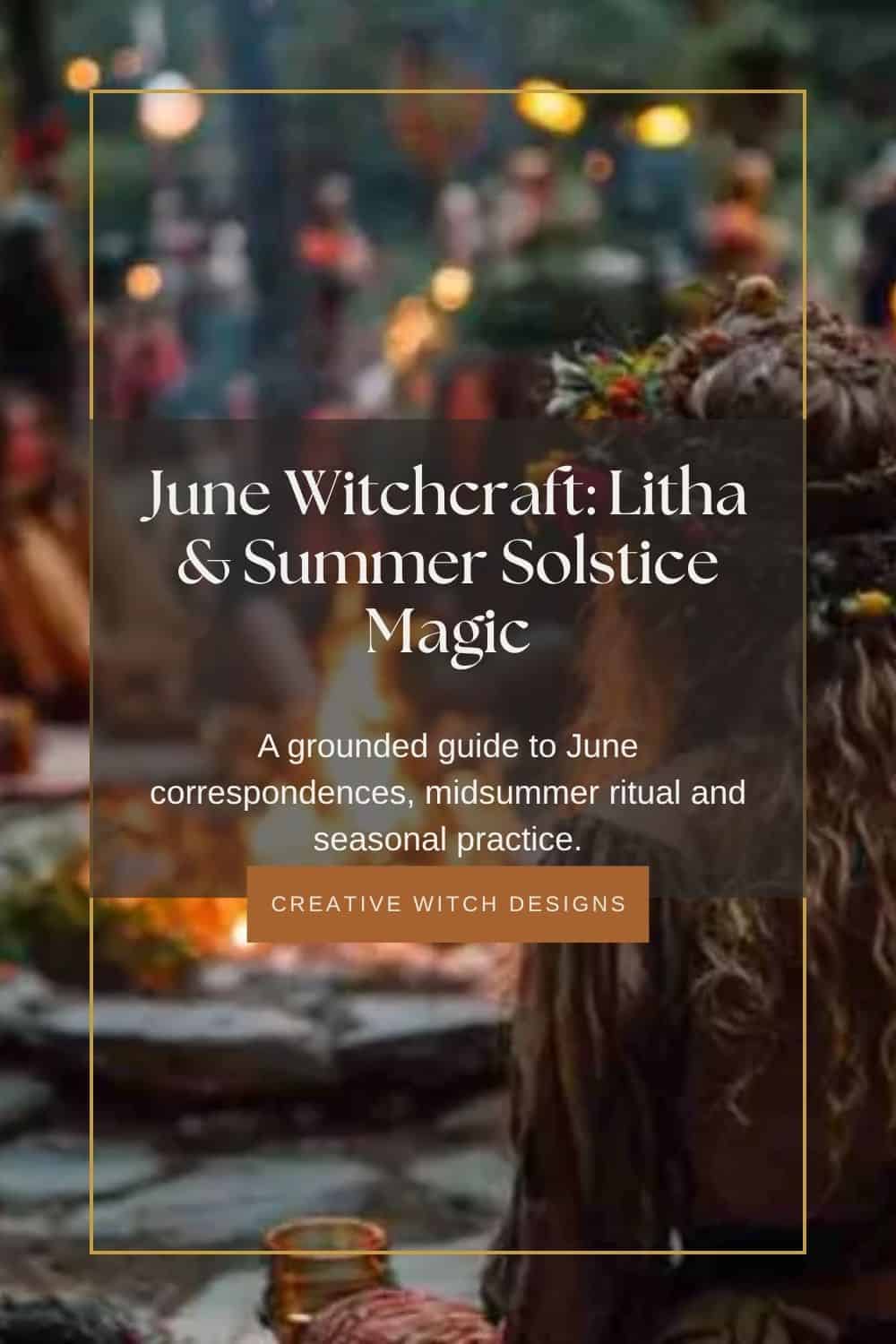
June carries the fullness of early summer. The hedgerows are thick with growth, gardens are abundant, the evenings remain light long after the working day has ended, and the sun reaches the height of its annual journey.
This is a month of visibility, vitality and culmination. What began quietly in spring is now easier to see. Flowers have opened, trees are in full leaf, insects are active, and the landscape feels generous in a way that is difficult to miss.
For seasonal witchcraft, June offers a natural moment to pause at the height of the light. The Summer Solstice, often celebrated as Litha or Midsummer, is not only about abundance and joy. It is also a threshold. The sun reaches its peak and, almost imperceptibly, begins its journey back towards the darker half of the year.
That duality gives June its particular depth. It is a time to celebrate what is full while remembering that fullness is never static.
The energy of June
June is expansive, warm and outward-facing. There is more light, more movement and often more social energy. The month naturally lends itself to gathering, celebration, creativity and time spent outdoors.
Yet beneath that outward abundance sits an important seasonal truth. The Summer Solstice is both a high point and a turning point.
The longest day arrives, and from that moment onwards, the daylight begins to shorten again.
This does not make the solstice melancholy. It makes it meaningful.
June reminds us that abundance is precious precisely because it changes. The season encourages enjoyment without grasping and celebration without pretending that anything remains at its peak forever.
What is Litha?
Litha is a modern name commonly used for the Summer Solstice within contemporary pagan and witchcraft traditions. It generally falls around 20 to 22 June in the Northern Hemisphere, depending on the astronomical solstice.
The solstice marks the longest day and shortest night of the year. Across different cultures, midsummer has historically been associated with fire, feasting, fertility, protection, herbs, divination, communal gathering and celebration of the sun.
Different traditions have their own customs, so there is no single historically universal way to celebrate Litha. Modern seasonal practice often brings together older midsummer customs with contemporary ritual, personal spirituality and connection with the land.
At its heart, the solstice is a recognition of light at its fullest.
June correspondences
June correspondences often draw heavily from the sun, flowering plants and the sense of abundance present in the landscape.
Colours associated with the month include gold, yellow, orange, deep green, white and warm red. These shades reflect sunlight, fire, vitality and the richness of summer growth.
Plants connected with June and midsummer include rosemary, lavender, chamomile, rose, calendula, elderflower and St John’s wort. The plants available to you will depend greatly on where you live, which is why local observation is always more valuable than blindly following a standard correspondence list.
Crystals often associated with solar themes include citrine, amber, carnelian, tiger’s eye and sunstone. Green stones such as peridot and jade can also reflect the fullness of the living landscape.
Common symbols of the season include the sun, fire, wheels, flowers, bees, herbs and circles.
The elements of fire and water can be especially useful to work with in June. Fire reflects the sun’s strength, while water offers balance, cooling and replenishment.
Create a solstice altar
A June altar can reflect both the brightness of the season and the turning point of the solstice.
You might use gold or yellow candles, fresh herbs, flowers, a bowl of water, seasonal fruit or a simple sun symbol.
Rather than filling the space with every traditional correspondence you can find, choose a few objects that genuinely connect you with the month.
One object might represent something you are celebrating. Another might represent gratitude. A third might acknowledge the coming shift towards shorter days.
This gives the altar a purpose beyond decoration.
Work with solstice fire
Fire has long been associated with midsummer celebrations, making it one of the clearest symbols of Litha.
You do not need a bonfire to work with that symbolism. A single candle is enough.
Light it at sunset or during the evening and reflect on what has gained momentum since the beginning of the year.
What has become clearer?
What has grown?
What deserves recognition?
Instead of turning the ritual into another exercise in asking for more, allow it to acknowledge what is already present.
The solstice can be a powerful point of gratitude before you move into the second half of the year.
Mark the midpoint of the year
June offers a natural pause for reflection because it sits close to the midpoint of the calendar year.
This does not need to become a performance review of your life.
Instead, look back with curiosity.
What began differently from the way you expected?
What has surprised you?
What have you quietly built?
What has lost its relevance?
What do you want to carry into the second half of the year?
Seasonal reflection becomes much more useful when it is observational rather than judgemental.
The intention is not to measure whether you have achieved enough. It is simply to notice where you are.
Gather and learn about midsummer herbs
Midsummer has a long association with herbs, and June is an ideal time to learn more about the plants growing locally.
Rather than gathering large quantities, choose one or two plants and explore them properly.
Learn their folklore, traditional uses and ecological role. Notice where they grow and what insects visit them.
If you harvest anything, make sure you can identify it safely, have permission where necessary, and take only a small amount.
This creates a much richer relationship with plant magic than collecting herbs simply because a correspondence list says they belong to Litha.
Make a sun wheel
A sun wheel is a simple seasonal craft that reflects the circular movement of the year.
You can make one from flexible branches, vines, straw, grasses, flowers or ribbons.
As you work, consider the idea of the wheel itself. The Summer Solstice is not an endpoint. It is one point within a cycle that is already continuing.
Hang the finished piece in your home, garden or sacred space for the summer.
The value is in the making and the symbolism rather than in creating something perfect.
Spend time with the sun consciously
Because June is so closely associated with solar energy, it can be tempting to turn the sun into another abstract magical symbol.
One of the simplest practices is simply to experience it.
Sit outside in the morning or evening when the light is gentler. Notice how the sun changes the colour of the landscape. Pay attention to warmth on your skin, the length of the shadows and the way plants orient themselves towards light.
Solar practice does not need to involve elaborate ritual.
Awareness is enough.
And, of course, enjoy the sun safely rather than deliberately exposing yourself during the strongest part of the day.
Balance fire with water
The Summer Solstice is often dominated by fire imagery, but water offers an important counterbalance.
June is also a month of sea, rivers, evening swims, summer rain and long drinks in warm weather.
You might spend time beside water, take a slow bath or place a bowl of fresh water on your solstice altar.
The symbolism is simple. Fire energises, while water replenishes.
Working with both can stop summer practice from becoming focused only on activity, productivity and expansion.
Create a seasonal feast
Food is one of the easiest ways to make seasonal celebration tangible.
A June feast might include strawberries, cherries, herbs, bread, salads, elderflower drinks, honey or whatever produce is abundant where you live.
The point is not to recreate an imagined ancient midsummer meal.
It is to notice what is available now.
Eat outside if the weather allows. Share the meal with others, or create something small for yourself.
A seasonal feast becomes meaningful because it connects celebration with the actual landscape and time of year.
Work with solar symbolism
June is a natural month for creating a solar charm, sigil or symbol.
You might draw a simple sun motif and associate it with confidence, warmth, creative energy or visibility.
Place it somewhere you will see it regularly rather than hiding it away.
The symbol then becomes a reminder of the quality you have chosen to work with.
As with any symbolic practice, the power comes from the meaning you give it and the actions you take alongside it.
Take a moonlit walk
June’s emphasis on sunlight can make lunar practice a useful contrast.
Walking in the evening after a bright summer day changes the atmosphere completely.
The air cools. Colours soften. Sounds become more noticeable.
A moonlit or twilight walk can be a beautiful way to experience the quieter side of midsummer.
Rather than asking for signs or messages, simply walk slowly enough to notice the difference between the daytime landscape and the one that emerges after sunset.
June and the wild landscape
June is one of the richest months for observing the land.
Wildflowers are plentiful, insects are active, birds are raising young and many plants are at their most recognisable.
Choose one regular walking route and pay attention to how it changes throughout the month.
Notice which flowers appear first.
Which disappear.
Which insects visit them.
Which trees cast the deepest shade.
Which places feel different at dawn and evening.
Over time, this kind of observation creates a relationship with place that cannot be replicated by generic seasonal lists.
June and ancestral remembrance
Midsummer has been marked in many different ways across generations and cultures, often through gathering, fire, food and celebration.
You do not need to claim a specific ancestral tradition to reflect on that continuity.
You might think about the people who experienced the same lengthening days before you, worked the land, prepared food, gathered herbs or celebrated summer in ways that have been forgotten.
A simple gesture of remembrance might be enough.
Light a candle.
Prepare a family recipe.
Tell a story.
Visit somewhere meaningful.
Ancestral connection does not always require a formal ritual.
June journal prompts
June is a useful month for reflecting on fullness, visibility and the passage of time.
You might ask yourself:
What has grown since the beginning of the year?
What deserves to be celebrated rather than improved?
Where am I experiencing genuine abundance?
What am I ready to carry into the second half of the year?
What has reached its natural peak?
Where would more rest create better balance?
What do I want to remember about this season?
These questions work particularly well around the solstice because they acknowledge both culmination and transition.
Let June be a celebration, not another task
The Summer Solstice does not need to become an elaborate spiritual performance.
You do not need twenty-six rituals, a perfectly decorated altar and an entire day of ceremony in order to honour the season.
You can light one candle.
Eat outside.
Notice the sunset.
Gather with people you love.
Walk through a field of summer flowers.
Acknowledge what has grown.
The magic of June lies in the fullness already around you.
You only need to notice it.
Want to celebrate Litha with other people?
If you would like to turn the Summer Solstice into a gathering, I have also written a separate guide to How to Host a Litha Party, with ideas for creating the atmosphere, seasonal food, decorations and simple activities.