
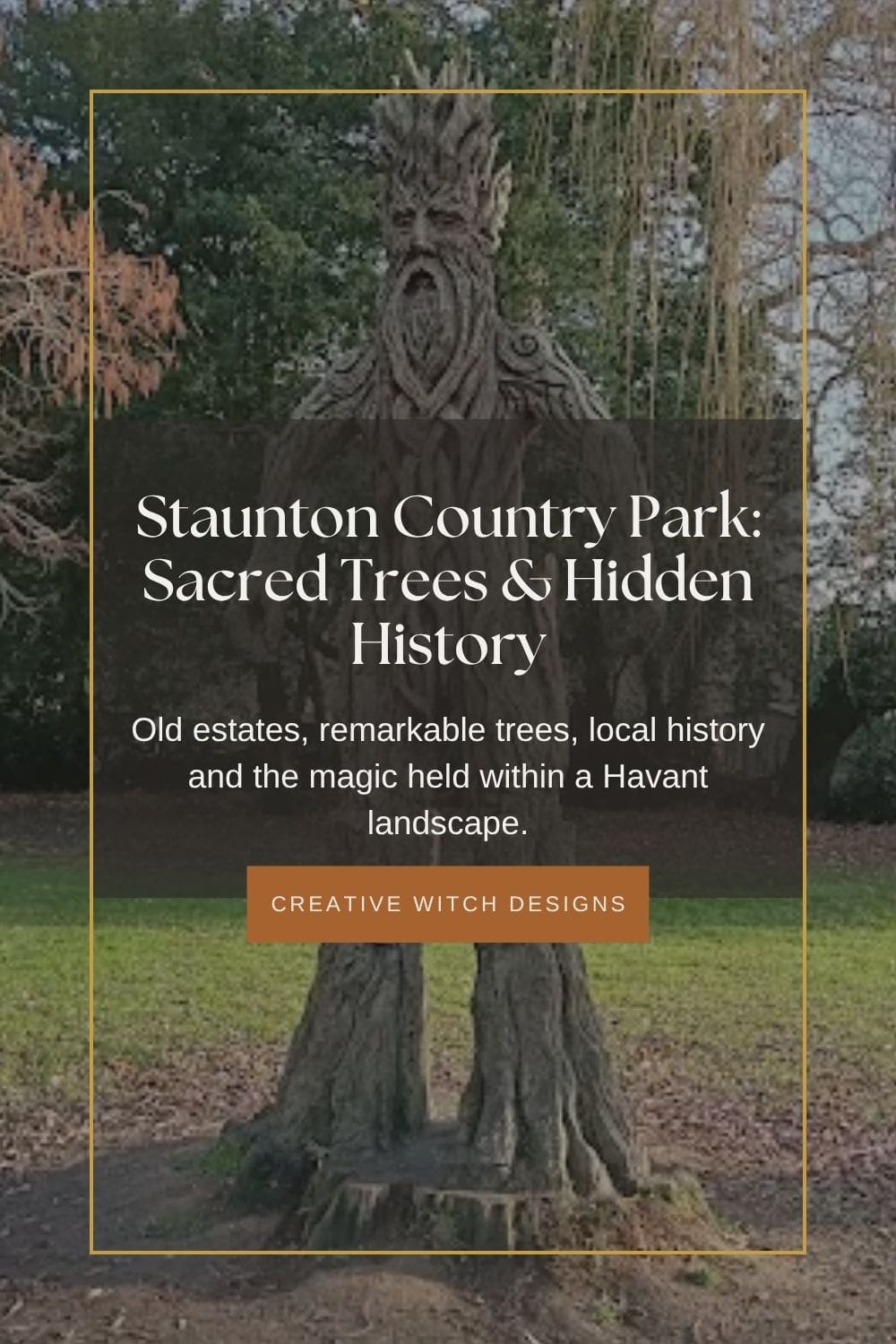
There are places I return to because they feel easy to love, and then there are places I return to because they keep revealing something new.
Staunton Country Park is one of those places.
It is familiar enough to feel ordinary. Families walk there. Dogs charge through the grass. Children visit the farm. People circle the lake, stop for coffee and move through the trees without necessarily thinking about what existed before them. Yet beneath that everyday surface is a landscape layered with old woodland, Regency design, imported trees, lost houses, wartime use, social history and the remnants of a much larger estate that was transformed almost beyond recognition.
That layering is what fascinates me.
As a witch, I am drawn to places where history and landscape seem to fold over one another. I like knowing what happened in a place, but I am equally interested in how it feels now, what has endured, what has disappeared, and how the land continues to carry traces of all those changes.
For me, history does not remove the mystery from a place. It adds to it.
A landscape that was never just one thing
Before Staunton Country Park existed, the land formed part of the Leigh Park estate and, earlier still, sat beside the ancient Royal Forest of Bere. The medieval landscape would not have looked like the manicured park we know today. It was a working mixture of woodland, pasture, routes, boundaries and human activity.
That matters to me because we often romanticise “sacred landscape” as though it must be untouched, remote or ancient in appearance.
But landscapes are rarely untouched. They are worked. Changed. Planted. Cleared. Built upon. Abandoned. Reclaimed.
What makes them meaningful is not purity. It is relationship. Staunton is a perfect example of that.
When the land became a designed world
The biggest transformation began in the early nineteenth century.
William Garrett purchased the estate in 1802 and began turning what had largely been agricultural land into ornamental grounds. The estate was shaped into a ferme ornée, a landscape where practical farming and aesthetic design were deliberately combined. Pleasure grounds, gardens and productive spaces began to sit side by side. (historicengland.org.uk)
I love that idea because it already blurs the line between usefulness and beauty.
A field can feed people and still be beautiful.
A garden can be productive and still feel magical.
A landscape can be designed and still hold spirit.
That is something I think modern witchcraft sometimes forgets when it places all sacredness in wild places. The cultivated can be sacred too.
Sir George Staunton and the imagination of place
When Sir George Thomas Staunton bought the estate in 1820, the landscape changed again.
His life had already taken him far beyond Hampshire. As a child he travelled to China as part of Lord Macartney’s diplomatic mission, later worked for the East India Company and became known for his knowledge of China and Asian culture. When he returned to England, those experiences found their way into the estate he created at Leigh Park. (hants.gov.uk)
He expanded the gardens, developed the lake, introduced unusual plants and added follies inspired by his travels and interests.
That is the part of Staunton’s history I find especially compelling. He was not simply landscaping land. He was translating memory into place. He was taking images, ideas and experiences from elsewhere and rooting them into Hampshire soil.
There is something deeply human in that. We all shape our spaces with memory. We bring home objects from journeys. We plant things that remind us of people or places. We create corners of our homes and gardens that somehow carry part of who we are.
Staunton did that on a much grander scale.
The magic of follies and unexpected places
Staunton’s follies are part of what gives the landscape its strange charm.
A folly is essentially a building created for effect, curiosity or beauty rather than necessity. It might imitate a temple, tower, ruin or distant architectural style.
In a designed landscape, they interrupt the ordinary.
You are walking through trees and suddenly something appears. A structure. A view. A point of pause.
That experience interests me because sacred landscapes often work in much the same way.
Certain places pull attention. A spring. A tree. A standing stone. A church. A ruin. A crossroads.
They interrupt movement and create a moment of awareness. You stop. You notice.
The landscape changes because your attention changes. Perhaps that is part of why follies still feel slightly magical now. They were built to create that pause.
Trees that travelled across the world
Staunton’s tree collection is one of the things that gives the park its distinctive character.
The park is now recognised as an arboretum, with trees and shrubs introduced from many parts of the world. Hampshire County Council notes that some of these plantings reflect the travels of Sir George Staunton and later owner William Henry Stone. Several specimens are nationally recognised for rarity or size, including Champion Trees. (hants.gov.uk)
I find that incredibly beautiful. A tree growing in Havant may have its ancestral roots thousands of miles away.
It arrived as seed or sapling, adapted to a new place, and eventually became part of the identity of that landscape.
That feels symbolic in a way I do not have to force. Landscapes carry migration too. Not just human migration, but botanical migration. Things move. Things root. Things become part of somewhere new.
The trees I have known there
My own connection with Staunton became more personal during a gathering beneath the trees.
We were surrounded by alder, hornbeam, willow, oak and hawthorn, species that already carry deep cultural and folkloric associations.
Hawthorn, in particular, has long been associated with boundaries, May traditions and the folklore of the Otherworld. Willow carries strong associations with water, grief, flexibility and moon symbolism. Oak has been linked with strength, endurance and sacred woodland across many European traditions. Alder often grows in wet ground and beside water, and its ability to endure when submerged has given it both practical importance and an uncanny place within folklore.
What interests me now is not simply saying that one tree “means” one thing.
I am much more interested in learning the tree itself.
Why does it grow there?
What soil does it prefer?
What birds use it?
What does its wood do?
What stories grew around it?
That is where folklore becomes more alive. The symbolism becomes rooted in the living thing rather than floating separately from it.
Trees as witnesses to change
Old trees change the way we experience time. A mature tree may have been standing before we were born and may still be there long after we are gone.
That makes trees natural symbols of ancestry and endurance, but there is also a literal truth behind the symbolism.
Some of Staunton’s trees have witnessed extraordinary changes around them. Different owners. Different houses. Gardeners and estate workers. Wartime occupation. Demolition. Housing development. Thousands of new residents. Families visiting the park decades later.
The trees did not witness these things in a conscious human sense, of course, but they remained while human life changed around them.
That is enough to make me pause.
From private estate to post-war community
One of the most important transformations in Staunton’s story came after the Second World War.
The wider Leigh Park estate had been used by the Admiralty during the war, but by 1946 Portsmouth City Council had purchased around 2,400 acres from the Fitzwygram family. Much of that land was acquired specifically to create desperately needed housing for families from Portsmouth, where bombing, overcrowding and existing housing shortages had created enormous pressure. (historicengland.org.uk)
Construction of the new Leigh Park estate began in 1947. Portsmouth City Council planned for around 25,000 people to live there in up to 7,000 homes, turning a huge portion of what had once been a private country estate into a major new residential community. (portsmouth.gov.uk)
I think this part of the story matters enormously. It would be easy to tell the history of Leigh Park purely as a story of loss. A country estate disappeared. Fields were built over. A mansion was demolished. But that would leave out the people. The land did not simply vanish. It changed purpose. Private space became homes.
A landscape once shaped around wealth and estate life became a place where thousands of ordinary families could live.
That is not a small historical footnote. It is one of the biggest transformations the land ever experienced.
The surviving gardens, ornamental farm, woodland and parkland around the lake were retained as public open space, leaving a fragment of the older estate embedded within the newer community. The mansion itself survived for a while but was eventually demolished in 1959. In 1987, the remaining historic landscape became Staunton Country Park. (hants.gov.uk)
There is something moving in that continuity. A private estate becomes public land. A place once accessible to relatively few becomes somewhere thousands of people can walk freely.
The sacredness of the place does not disappear because its social purpose changes. If anything, the relationship widens.
The lost house and what remains
The mansion no longer stands. That absence interests me.
We are used to reading landscapes through what we can see, but sometimes the most powerful parts of a place are the things that have gone.
A house once dominated the view. People lived and worked there. Rooms were furnished. Meals were served. Guests arrived. Gardeners crossed the grounds. Then the building disappeared. The land remained.
That kind of absence creates a different form of presence. Once you know something stood there, you can never quite look at the empty space in the same way.
This is one of the reasons I love history so much. It changes what you can see.
The kitchen gardens and the quieter magic of cultivation
Staunton was not only an ornamental estate. Its walled kitchen gardens were practical and productive.
Fruit, vegetables and other crops were grown to supply the household, and the surviving Storey Gardens occupy part of that old productive landscape today. Historical records describe glasshouses, forcing pits, orchard trees and crops grown within the walls. (hants.gov.uk)
This is another part of Staunton that resonates strongly with me. There is often a tendency to treat spirituality as something separate from practical life. But growing food is deeply connected to season.
So is preserving. So is planting. So is tending soil. So is waiting.
A kitchen garden contains all the things witchcraft talks about constantly: cycles, patience, death, regeneration, abundance, failure, weather, timing and care.
You do not need to call it ritual for it to be sacred.
Water and the way it changes a landscape
Water has always been one of the elements I am most drawn to.
At Staunton, the lake became one of the defining features of the designed estate, reflecting both the landscape and the Regency love of picturesque scenery. It opened views, reflected trees and changed the way people moved through the grounds. (historicengland.org.uk)
My own relationship with water there is more personal.
During the gathering I once held beneath the trees, we spent time close to a natural water source and gathered fresh water mint nearby.
What stayed with me was not the idea that I needed the water to give me a message.
It was the atmosphere.
Water changes sound. Air feels different around it. Plants change. Insects change. The ground changes. You notice things simply because you stop. That, for me, is part of sacred practice. Attention changes place.
The deer that appeared between the trees
During that same gathering, a doe and her fawn appeared. It would be very easy to give that encounter a neat spiritual meaning. Deer symbolise this. The mother and fawn represent that. The universe was telling us something. But I have become less interested in forcing meaning onto moments like that.
Perhaps it mattered simply because it was beautiful. A wild animal appeared unexpectedly. Everyone stopped. For a few seconds, the atmosphere changed completely.
That is enough.
The reason deer appear so often in folklore may begin with exactly this kind of experience. They appear quietly. They move at the edge of woodland. They disappear quickly. They seem both present and unreachable.
Humans have been turning moments like that into story for thousands of years.
The Forest of Bere beneath everything
Staunton also sits beside the older history of the Forest of Bere.
During the medieval period, this was part of a much larger Royal Forest landscape made up of woodland, pasture, heath, settlements and hunting grounds. A royal forest was not simply a dense wood. It was a legally controlled landscape with its own rights, restrictions and relationships between people, animals and land. (historicengland.org.uk)
The Forest of Bere adds another layer to the way I experience Staunton.
Forests occupy a special place in mythology and folklore because they often represent the place beyond certainty. You leave the road. Visibility changes. Paths divide. Sound becomes different. The forest can shelter, feed, conceal and disorientate.
It is easy to understand why old stories so often begin when someone enters the wood. The forest becomes the place where ordinary rules are suspended.
Where history and witchcraft meet
This is the real reason I love places like Staunton.
I do not want to choose between history and witchcraft. I want both. I want to know who owned the land. I want to know which trees were planted and why. I want to know what buildings disappeared. I want to know what the gardens produced, and then I want to walk there and feel what all of that knowledge changes.
History gives me context. Folklore gives me story. Botany gives me understanding. Witchcraft gives me relationship.
The magic comes from allowing those things to sit together.
Sacred science and the pleasure of knowing more
I sometimes think of this meeting point as sacred science.
Not because I believe science needs to become mystical, but because learning how something actually works has never made it feel less magical to me.
Knowing why alder thrives beside water does not diminish the symbolism of the tree.
Knowing that a lake was deliberately created does not make its reflection less beautiful.
Knowing that unusual trees were imported deliberately from overseas does not make the arboretum less wondrous.
If anything, knowledge deepens the experience.
The sacred does not require ignorance.
Mystery does not disappear simply because we understand more.
Sometimes the opposite happens.
The more you know, the more extraordinary the ordinary becomes.
Walking Staunton with different eyes
The next time you walk through Staunton, you might try experiencing it as more than one landscape at once.
See the public park that exists now.
Imagine the mansion that once stood there.
Think about the gardeners working inside the kitchen walls.
Remember that some of the trees travelled from other parts of the world before becoming rooted here.
Consider the older Forest of Bere.
Think about the families who moved into Leigh Park after the war and made entirely new lives on land that had once belonged to a private estate.
Then simply notice what is happening around you in the present.
Birdsong.
Children.
Dogs.
Wind moving through leaves.
Water reflecting sky.
People resting beneath trees.
That is the landscape now.
It does not need to become frozen in the past to retain meaning.
A place can be many things at once
Staunton is not one story.
It is woodland.
Estate.
Garden.
Farm.
Private landscape.
Wartime site.
Lost mansion.
Public park.
Arboretum.
Local memory.
And, for some of us, sacred landscape.
Those identities do not compete.
They accumulate.
Perhaps that is why the place continues to fascinate me.
Every time I return, I am walking through several versions of the same ground.
And somewhere between the history I can research and the things I can only experience lies the reason I keep returning.
That is where the witch in me feels most at home.
Explore Havant’s hidden landscape
Staunton is part of a much larger local story. The springs beneath Havant, Roman roads and villas, the tidal landscape of Langstone, the ruins and churchyard at Warblington, the Roman kilns and Norman earthworks around Rowlands Castle, and the changing landscape of Havant Thicket all belong to the same wider tapestry of place, memory and human occupation.
You can begin with:
Havant’s Hidden Landscape: Sacred Springs, Roman Roads & the Old Paths Beneath Our Feet
As this series develops, I will continue following those threads through history, folklore, myth and sacred landscape.