
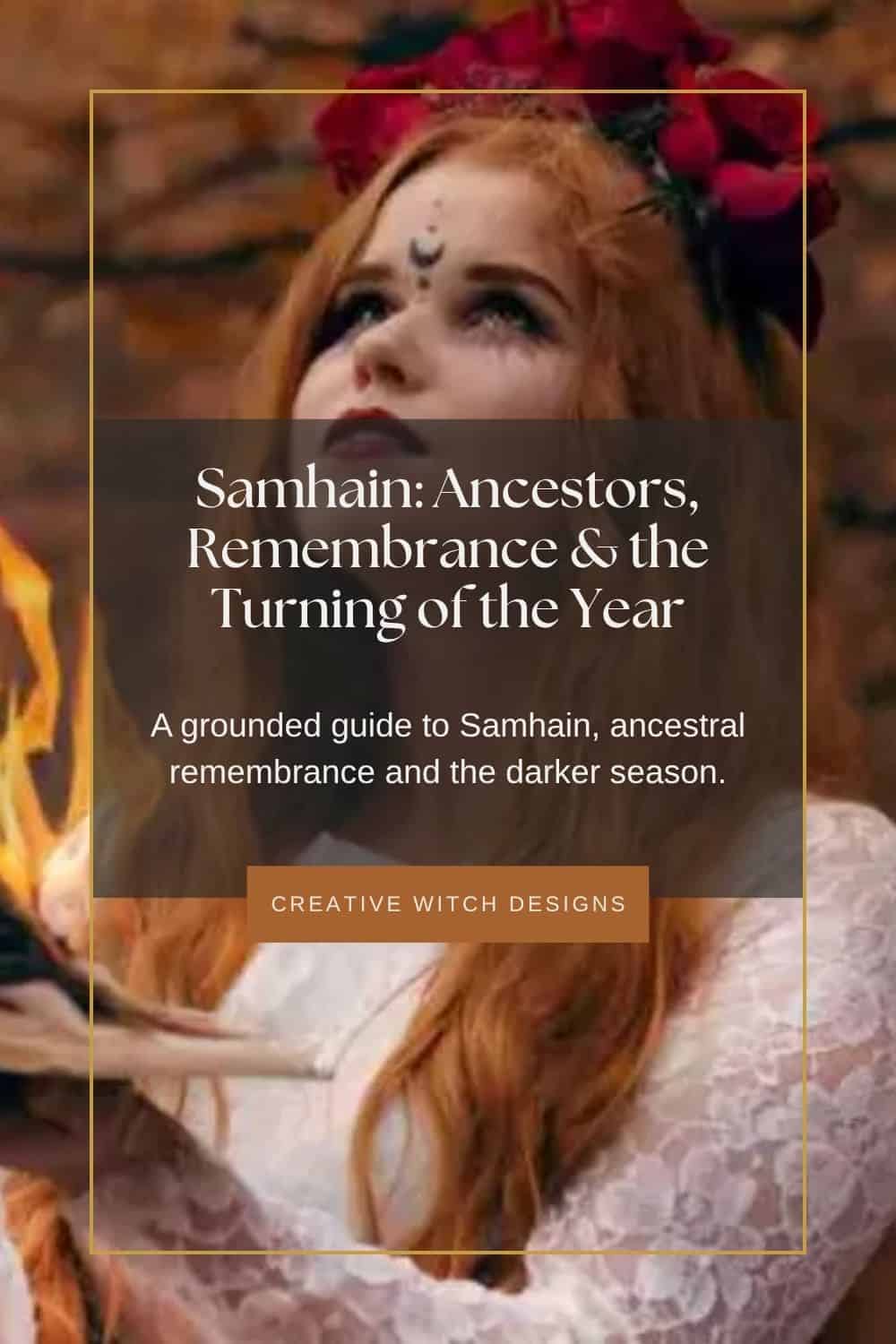
Samhain arrives at one of the most atmospheric points in the seasonal year.
By late October, the harvest is largely complete, trees are shedding their leaves and darkness arrives noticeably earlier. The landscape itself appears to be withdrawing.
For modern pagans and witches, Samhain is commonly observed around 31 October and 1 November. Its roots lie in Gaelic seasonal tradition, where Samhain marked the transition into the darker part of the year and the end of the harvest season.
Contemporary practice has also developed around remembrance, ancestors, divination, fire and the idea that the boundary between the living and the Otherworld becomes more permeable at this time.
Some modern witches describe Samhain as the Witch’s New Year. That is a contemporary spiritual interpretation rather than a universal historical description, but it can still offer a meaningful way of marking the end of one seasonal cycle and the beginning of another.
The historical roots of Samhain
Samhain was traditionally associated with a significant seasonal transition.
The agricultural year was changing. Livestock were brought down from summer grazing. Food was stored. Communities prepared for winter.
This was not simply a mystical idea.
Winter brought genuine uncertainty.
The success of the harvest and the ability to preserve food mattered enormously.
Seasonal gatherings therefore carried practical, social and spiritual significance.
Fire, feasting, storytelling and communal activity all became part of the atmosphere surrounding the transition into winter.
Samhain and the Otherworld
One of the most enduring themes associated with Samhain is liminality.
In Irish folklore and later traditions, this period became connected with the idea that boundaries between this world and the Otherworld were less fixed.
Stories of spirits, supernatural beings and the dead naturally became associated with the festival.
For contemporary practitioners, this is often expressed through the idea that the veil between worlds becomes thinner.
Whether you understand that literally, symbolically or as part of folklore, Samhain creates a natural cultural space for remembering those who came before.
Create an ancestor table
One of the simplest ways to mark Samhain is to create a small space dedicated to remembrance.
Use photographs, names, objects or heirlooms connected with people you want to remember.
Add candles, seasonal fruit, bread or flowers if you wish.
The important part is not how elaborate the altar looks.
It is the act of remembering.
You might speak their names.
Tell a story about them.
Cook something they loved.
Sit quietly with a photograph.
Ancestral remembrance can be profound without becoming complicated.
Share food in remembrance
Food and remembrance belong naturally together.
Family recipes often carry memory more vividly than almost anything else.
You might prepare a dish associated with someone who has died, bake bread, cook an autumn meal or make a favourite dessert.
Set aside a symbolic portion if that is part of your practice, or simply raise a glass and remember them.
The value lies in keeping memory connected with ordinary life.
Explore divination at Samhain
Samhain has long been associated in folklore with divination and attempts to glimpse what might lie ahead.
Modern practice might include tarot, oracle cards, runes or scrying.
Try keeping your questions grounded.
What am I carrying into the next season?
What deserves closure?
What have I learned this year?
Where am I being asked to trust myself more?
Divination works particularly well at seasonal thresholds because it creates space to consider change.
Light a lantern
Lanterns are one of the most evocative symbols of this time of year.
You might carve a pumpkin or turnip, light a candle in a window or place lanterns around your home.
Historically, carved vegetable lantern traditions developed in different ways across Britain and Ireland, with turnips particularly associated with earlier customs before pumpkins became widespread through later Halloween traditions.
A lantern can be protective, decorative or simply seasonal.
It creates light precisely because the darkness is increasing.
That is symbolism enough.
Visit a graveyard with respect
If you have family graves nearby, Samhain can be a meaningful time to visit them.
Bring flowers.
Clean a headstone if appropriate.
Spend some time there.
If you visit an unfamiliar graveyard because you appreciate its history or atmosphere, remember that it is first and foremost a place where people are buried and mourned.
You do not need to leave food, coins or objects behind.
Quiet respect is enough.
Tell the stories of the dead
Samhain remembrance does not need to be silent.
Tell stories.
Talk about grandparents, parents, friends or people further back in your family.
Share funny memories as well as serious ones.
Look at photographs together.
Ask older relatives questions while you still can.
The people who came before us become more tangible when their stories continue to be spoken.
Work with fire as a symbol of transition
Fire fits naturally into Samhain because it creates warmth and light as the year moves into darkness.
Light a candle or fire and think about what has completed its cycle.
You do not need to force a dramatic rebirth narrative.
Perhaps something simply ended.
Perhaps something changed.
Perhaps you are still unsure what comes next.
A seasonal threshold does not always require an answer.
Sometimes it is enough to recognise that you have crossed one.
Create a Samhain spirit doll
If you enjoy craft, you might make a small figure from cloth, wool, corn husks or natural fibres.
Rather than treating it as an object that literally contains a spirit, you can use it as a symbolic representation of ancestry, protection or remembrance.
Choose materials deliberately.
Add herbs, stitching, colours or symbols that have meaning to you.
The making becomes a way of giving physical form to memory and intention.
Samhain and the darker half of the year
Samhain is often described as the beginning of the darker half of the year.
That darkness does not need to be treated as something threatening.
Winter invites a different pace.
There is less daylight.
The landscape becomes quieter.
Growth retreats underground.
Much of nature enters dormancy.
Samhain can therefore become a point at which we consciously stop expecting ourselves to remain in summer mode all year.
That may be one of its most useful lessons.
Samhain reflection prompts
You might explore:
Whose stories do I want to remember?
What has genuinely ended this year?
What have I learned from that ending?
What traditions do I want to preserve?
What would I like the darker months to contain?
Where am I ready to become quieter?
What do I want to carry with me?
Let remembrance be enough
Samhain does not need to be frightening, theatrical or emotionally intense.
You do not have to contact spirits.
You do not have to perform a dramatic ritual.
You do not have to turn every ending into transformation.
You can light a candle.
Cook a meal.
Say a name.
Tell a story.
Remember someone.
Stand outside beneath a dark October sky.
Sometimes remembrance itself is the ritual.
Want to gather around the table?
If you would like to mark Samhain with friends or family, read:
How to Host a Samhain Supper