
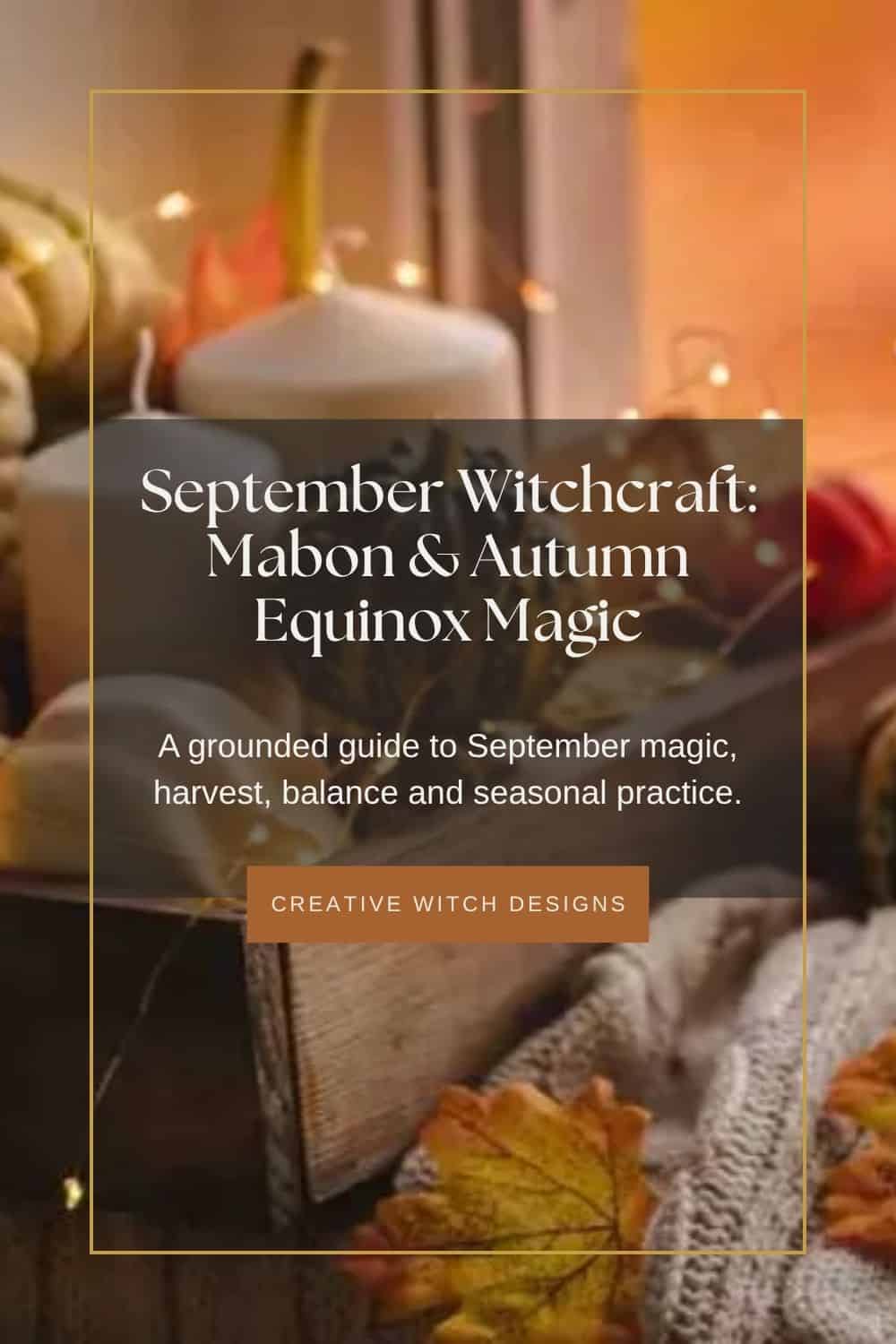
September arrives quietly compared with the boldness of high summer. The light softens, mornings become cooler, berries darken on the hedgerows and the first leaves begin to show signs of change. There can still be warmth in the days, but the landscape is unmistakably shifting.
This is what makes September such an interesting month for seasonal witchcraft. It is neither fully summer nor fully autumn. It occupies the threshold between the two, asking us to notice change while we are still surrounded by abundance.
At the centre of the month sits the Autumn Equinox, when day and night are approximately equal in length before the Northern Hemisphere moves more noticeably towards longer nights. Many contemporary pagans refer to this seasonal celebration as Mabon.
September therefore carries themes of balance, harvest, gratitude, transition and preparation. It offers an opportunity to appreciate what has grown while beginning to consider what you want to carry with you into the darker part of the year.
The energy of September
August introduces the harvest. September deepens it.
The focus begins to move away from producing and gathering towards assessing what has actually been collected. There is still abundance around us, but there is also a stronger awareness of limits.
Not everything needs to be carried forward.
Not everything needs another season.
This makes September a useful month for refinement. You can look at what has worked, what deserves continued attention and what has reached a natural conclusion.
There is something practical about this point in the year. Nature is not endlessly expanding. Energy is being redistributed. Seeds are forming, leaves are beginning to turn and animals respond to subtle changes in temperature and daylight.
Seasonal practice can mirror that movement without becoming another exercise in productivity.
What is Mabon?
Mabon is the name commonly used by many modern pagans for the Autumn Equinox celebration. The term itself is relatively modern rather than the name of an ancient universal equinox festival, although harvest celebrations around this time of year have existed in many different cultures.
That distinction is useful because it allows us to celebrate the equinox without trying to create a single historical tradition where none existed.
Contemporary Mabon practice often focuses on harvest, gratitude, balance, food, community, the changing landscape and preparation for the darker months.
For some people, it is celebrated formally as part of the Wheel of the Year. For others, it is simply a meaningful seasonal marker.
Either approach can work.
September correspondences
September’s colours naturally reflect the landscape as summer begins to fade into autumn.
Deep gold and amber echo ripened grain and the lowering sun. Rust, crimson and burgundy reflect changing leaves and berries, while olive and darker greens acknowledge that much of the landscape is still very much alive.
Plants associated with September often include apple, rosemary, chamomile, late berries, grain, sage and the first autumn fruits.
Crystals traditionally associated with themes of grounding and transition include smoky quartz, carnelian, moss agate and sapphire, which is also September’s birthstone.
Seasonal symbols might include apples, acorns, grain, baskets, leaves, nuts, scales, candles and the hearth.
You do not need to use all of these. Correspondences become more meaningful when they reflect the September you can actually see around you.
Notice balance in the landscape
Because the Autumn Equinox is associated with balance, it is tempting to treat September as a month in which every part of life should somehow become perfectly balanced.
Nature does not really work like that.
The equinox itself is a moment within a transition. The balance does not remain. Light continues to decrease and the season continues to change.
That makes balance a much more interesting subject.
Rather than asking whether everything in your life is equal, consider what needs adjustment.
Where are you giving more than you can sustain?
Where has something been neglected?
What has become unnecessarily complicated?
What could be simplified before the year moves further into autumn?
Balance is not a permanent state. It is something we continually respond to.
Create an Autumn Equinox altar
A September altar can reflect both harvest and transition.
Apples, acorns, grain, berries, leaves, candles and seasonal herbs can all work beautifully. Choose things that are genuinely present around you rather than trying to collect every traditional Mabon symbol.
You could also include two objects representing the relationship between light and dark.
They do not need to symbolise good and bad. Darkness is not the opposite of goodness, just as light is not automatically positive.
Instead, you might use them to represent activity and rest, visibility and privacy, outward movement and introspection.
That gives the symbolism more depth than simply trying to create perfect symmetry.
Make apples part of your seasonal practice
Apples belong naturally to September in Britain and carry an enormous amount of folklore and symbolism.
They have been associated with harvest, abundance, love, knowledge and the otherworld in different European traditions.
Rather than using an apple simply because it appears on a correspondence list, you could explore its history more deeply.
Visit an orchard if you have one nearby.
Learn about heritage varieties.
Bake with apples.
Cut one horizontally and notice the star formed by the seeds at its centre.
The ordinary apple becomes much more interesting when you look closely at the stories surrounding it.
Hold a simple equinox reflection
The equinox provides a natural point to pause and look back at the year so far.
You might light a candle, make a drink and spend some time with a journal.
Begin with what has gone well.
What are you genuinely grateful for?
What has developed since spring?
What surprised you?
Then move into what needs adjustment.
There may be goals you no longer care about, obligations that have become too heavy or ideas that no longer fit where you are going.
September reflection does not need to become a dramatic release ceremony.
Sometimes recognising that something has changed is enough.
Bring the harvest into the kitchen
September is an especially good month for seasonal cooking.
Apples, blackberries, squash, root vegetables, grains and late-summer produce begin to create richer, warmer meals.
Bake something.
Make soup.
Cook an apple crumble.
Preserve fruit.
Prepare a meal using produce grown locally if that is available to you.
Kitchen practice fits beautifully with the harvest season because it takes what the land has produced and turns it into something that nourishes.
The magic lies as much in the ordinary process as it does in any spoken intention.
Walk the changing landscape
September is one of the best months for noticing transition because it happens gradually.
Choose somewhere you already know and visit it more than once during the month.
At first, very little may appear different.
Then you begin to notice.
A tree changes colour.
Berries disappear.
The ground becomes wetter.
Mornings feel colder.
The light falls differently.
These small observations teach you much more about the turning year than trying to force autumn symbolism before the landscape is actually ready.
Work with what you are ready to put down
Harvest inevitably involves selection.
Something is gathered. Something is left. Something has completed its purpose.
September can therefore be a useful time to consider what you no longer want to carry.
This does not need to involve burning lists or performing a dramatic release ritual.
You might clear a drawer.
Finish an unfinished task.
Cancel something that no longer makes sense.
Give something away.
Close a project.
Make a decision.
Physical action can sometimes be a more powerful marker of transition than symbolic action alone.
Turn towards the home
As the evenings begin to shorten, September naturally starts drawing attention towards the home.
This is a good time to look around your space and consider what would make the colder months feel more comfortable.
Wash blankets.
Clear clutter.
Bring out candles.
Organise a reading corner.
Check what needs repairing.
Begin stocking foods you use regularly.
These ordinary acts of preparation belong to seasonal living just as much as ritual does.
Our ancestors prepared for colder months because they had to. We may live very differently now, but there is still something satisfying about responding to the season practically.
Explore harvest folklore
September provides a rich opportunity to explore local history and folklore around harvest.
Look at customs from your own area.
Were there harvest suppers?
Corn dollies?
Apple traditions?
Local fairs?
Songs or celebrations associated with gathering crops?
This is where The Creative Witch Journal can become particularly distinctive.
Rather than reproducing generic lists of pagan practices found across countless websites, you can begin connecting seasonal witchcraft with actual British landscape, folklore and place.
That gives the subject far more texture.
September and ancestral remembrance
Harvest also offers a natural point for remembering the people whose work made ordinary life possible.
Not only distant ancestors, but generations of farmers, gardeners, bakers, millers, cooks and people who knew how to preserve what the land provided.
You might honour that history through something practical.
Make a family recipe.
Learn a traditional preserving technique.
Ask someone older about harvest traditions they remember.
Research the agricultural history of where you live.
Ancestral remembrance can be quiet and tangible.
It does not always need to involve ceremony.
Create a September seasonal record
September is worth documenting because the landscape can change noticeably in only a few weeks.
Keep a page in your journal or grimoire for what you actually observe.
Record the first tree you see changing colour.
The first really cold morning.
Which berries remain.
Which birds appear.
What is growing in gardens and fields.
What you are eating.
What you find yourself naturally wanting to do as the evenings draw in.
Over time, these notes become your own set of seasonal correspondences.
September journal prompts
September lends itself naturally to reflection around balance, harvest and transition.
You might explore:
What am I genuinely grateful for from this year?
What has reached completion?
What deserves to be carried forward?
What feels heavier than it needs to?
Where do I need to make an adjustment rather than force balance?
What would help me feel more prepared for autumn?
What am I learning from the changing landscape?
Which simple rituals or routines would I like to carry into the darker months?
These questions allow September to remain grounded in transition rather than turning every seasonal theme into another exercise in personal transformation.
Let September be a threshold
September does not ask us to rush into darkness.
There is still warmth.
There is still abundance.
There are still late flowers and long afternoons.
But something has shifted.
The balance of light is changing.
The harvest is coming in.
The landscape is beginning to withdraw.
Seasonal witchcraft at this time of year can simply mean paying attention to that threshold.
Gather what matters.
Prepare what needs preparing.
Put down what has finished.
Eat the apples.
Notice the leaves.
Light the candle a little earlier.
Autumn will arrive in its own time.
Want to celebrate Mabon with others?
If you would like to mark the Autumn Equinox with friends or family, I have also written a separate guide to How to Host a Mabon Gathering, with ideas for seasonal food, decorations, activities and a simple shared ritual.