
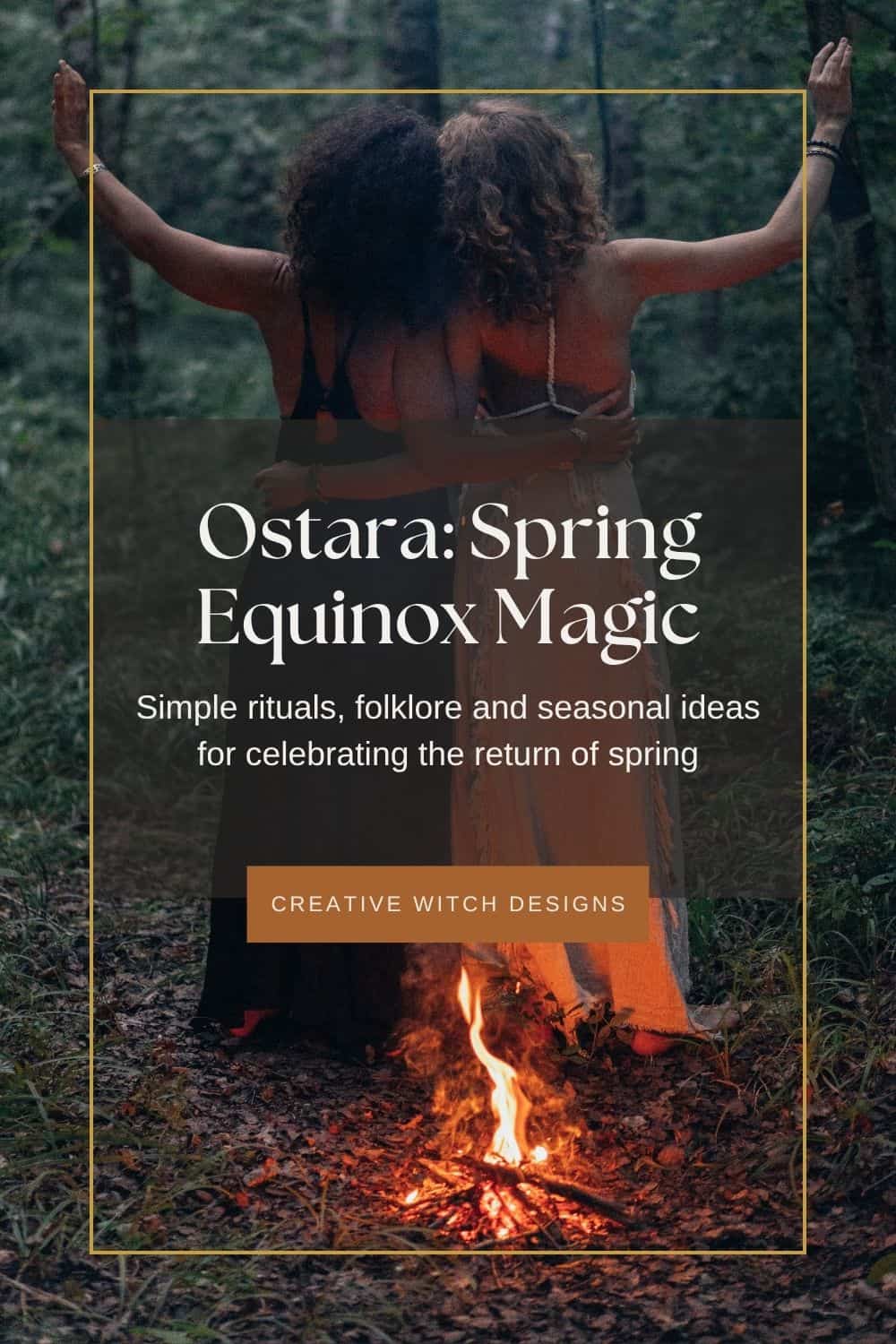
Around the 20th of March in the Northern Hemisphere, the Spring Equinox marks the moment when day and night are approximately equal before the balance tips towards longer days. Within many modern Pagan traditions, this seasonal turning is celebrated as Ostara, a time associated with awakening, growth, fertility and the return of visible life after winter.
There is something about this particular point in the year that always feels full of possibility. The change is no longer hidden beneath winter soil because buds are beginning to open, birds are becoming noisier and the evenings are noticeably lighter. Ostara gives us an opportunity to notice that movement and consider what we might be ready to bring into our own lives as the season changes.
Eostre, Ostara and the stories of spring
The history behind the name Ostara is less straightforward than many modern retellings suggest. The eighth-century writer Bede referred to an Anglo-Saxon month called Eosturmonath, which he said had once been named after a goddess called Eostre. Centuries later, Jacob Grimm used the reconstructed Germanic name Ostara, and the word eventually became associated with the modern Pagan celebration of the Spring Equinox. Beyond Bede’s brief reference, however, very little is known about Eostre or any historical rites that may have been connected with her.
I actually find that uncertainty more interesting than pretending we know more than we do. Folklore, reconstruction and modern spiritual practice have all contributed to the Ostara celebrated today, which means we can acknowledge the gaps while still finding meaning in the season.
Eggs, hares, flowers and young animals have become familiar symbols of spring because they naturally speak of fertility, birth and returning abundance. We do not need to prove that every one of these symbols belonged to a single ancient Ostara festival before we can appreciate why they make sense at this time of year.
The magic of balance
The Equinox is often described as a moment of perfect balance between light and darkness. Astronomically, the reality is slightly more complicated than an exact twelve hours of each everywhere, but symbolically the idea of balance remains powerful.
For me, balance is not about trying to divide life perfectly into equal pieces. It is about noticing where something has become lopsided and deciding what needs more space. Spring can bring an urge to rush into doing everything at once, yet the Equinox reminds us that growth still needs rest, action still needs reflection and beginnings benefit from strong roots.
A very simple Ostara practice is therefore to ask where you need to rebalance before pushing forward.
Simple Ostara rituals
You do not need an elaborate altar or complicated ceremony to mark the Spring Equinox. Planting seeds can become a beautifully literal ritual because you can choose one intention to accompany what you are growing and allow the plant to remind you that growth takes time rather than appearing instantly.
Decorating eggs can also become an intentional practice, using colour, symbols or words connected with something you want to cultivate through spring. If you prefer something quieter, light two candles to represent darkness and light, then spend a few minutes considering what winter taught you and what you are now ready to move towards.
I also love the idea of celebrating Ostara through simple enjoyment. Bake something, bring spring flowers into the house, walk somewhere you can see the first signs of new growth or spend an afternoon creating simply because it feels good. Seasonal witchcraft does not always need to become serious work.
Creating an Ostara altar
An Ostara altar can reflect what is actually happening around you rather than following a rigid correspondence list. Spring flowers, fallen twigs, naturally discarded feathers, seed packets or a small bowl of decorated eggs can all represent the season without requiring anything particularly elaborate.
Colours such as fresh green, yellow, soft pink and lavender naturally echo early spring, while crystals including green aventurine, aquamarine or moonstone can be included if they already hold meaning within your practice. The most interesting altar will usually be the one that reflects your own relationship with spring rather than somebody else’s checklist.
What are you ready to grow?
Ostara arrives at a point when the world around us is becoming visibly active again, but growth is still tender. New leaves can be damaged by frost, seeds need time beneath the soil and not everything that begins will flourish immediately.
That feels like a useful reminder for our own beginnings too.
You do not need to emerge from winter fully formed or suddenly transformed. You only need enough movement to begin.
Ostara invites us to notice what is returning, choose what we want to nurture and allow ourselves to grow at the same steady pace as the season around us.