
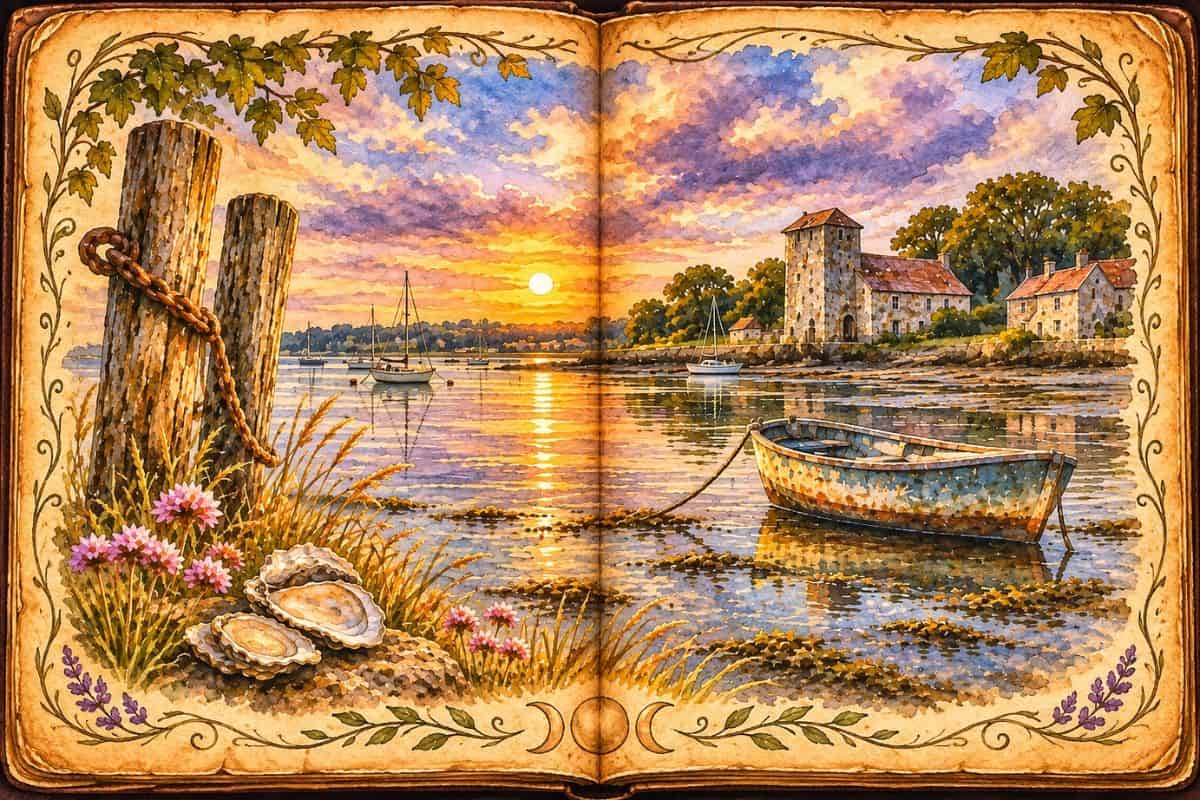
Langstone has always felt like a place where the land begins to loosen its grip and give way to something wider. Havant sits inland, shaped by springs, roads and settlement, while Langstone opens outward towards mudflats, tidal channels, salt water and an enormous stretch of sky. The harbour never looks quite the same twice because the tide continually redraws its boundaries, covering ground that was exposed only hours earlier and then retreating again to reveal mud, channels, shell beds and feeding birds.
That constant movement is one of the reasons I find Langstone so compelling from a witchcraft perspective. Tidal places resist being fixed because they are neither completely land nor completely sea, and their character changes according to the pull of the Moon, the weather and the changing season. Long before I began researching Langstone’s history, I responded instinctively to that sense of transition because it makes natural cycles visible in a way that few landscapes can.
The history makes that relationship even richer because Langstone was never simply a picturesque coastal village. It was Havant’s connection with the sea, a place where goods arrived and departed, oysters were harvested, salt was produced, fishermen and wildfowlers worked according to the tides, smugglers navigated the harbour’s hidden channels, and eventually a railway carried people and produce across the water towards Hayling Island. The harbour has always been both beautiful and practical, and that combination is exactly what interests me.
Havant’s doorway to the sea
By the medieval period, Langstone had become the recognised port for Havant. Havant Borough Council’s conservation material describes it as an established commercial harbour where materials such as wood, coal, grain, sand and gravel passed between land and sea, connecting the inland town with coastal trade and communities beyond Hampshire. (havant.gov.uk)
That relationship helps explain why Langstone belongs so naturally within the wider story of Havant. The town did not simply stop where the buildings ended because its economic and social life extended southwards along old routes towards the harbour. Havant Borough Council’s heritage material records an old north-to-south route leading towards Langstone Harbour, existing alongside the east-to-west routes that crossed the area and made Havant an important meeting point for movement across the landscape. (havant.gov.uk)
A harbour can look like the edge of a landscape when viewed on a modern map, yet historically it was often an opening rather than an ending. People, food, fuel, information and ideas moved through water, and communities that appear geographically separate were connected by boats, tides and trade. When I think about sacred landscape, these practical connections matter because they show how people have always created relationships between places rather than experiencing them as isolated points.
Roman footsteps beside the harbour
Langstone’s relationship with movement began long before its medieval port developed. The wider Havant landscape contains substantial evidence of Roman occupation, including roads, villas and industrial sites that linked settlements across what is now the borough. Havant Borough Council’s archaeological assessment records Roman activity along routes connecting Havant, Warblington, Langstone and Littlepark, while another route ran north towards the pottery and tile-making areas around Rowlands Castle. (havant.gov.uk)
The Langstone Conservation Area appraisal specifically records the remains of a Roman villa north of the modern village, close to Langstone Avenue. (havant.gov.uk) Farther inland, the substantial Roman villa near what is now South Downs College occupied a position overlooking the harbour, and Historic England records evidence of rooms arranged along a south-facing portico with views towards the coast. (historicengland.org.uk)
I find that detail particularly evocative because it makes the Roman landscape feel unexpectedly personal. Nearly two thousand years ago, somebody could stand within a substantial Roman home north of Havant and look towards the same stretch of water that still defines the horizon today. The coastline has changed and almost everything around it has been reshaped, but the harbour remained an important presence within the landscape.
Salt and the oldest kind of alchemy
Salt is one of the oldest and most fascinating threads within Langstone Harbour’s history. The harbour authority records salt production here over many centuries, with three salterns mentioned in the Domesday Book and salt-making continuing at various locations around the harbour until much more recent times. (langstoneharbour.org.uk)
Traditional salt production depended upon an intimate understanding of seawater, weather, evaporation and timing. Water was brought into shallow areas where the sun, wind and human labour gradually concentrated the salt until something previously dissolved and invisible could be gathered as crystal. That process feels almost alchemical because water is transformed, mineral becomes visible and an ordinary natural substance becomes essential to food, preservation, trade and survival.
Salt later acquired enormous symbolic importance within folklore and magical practice, particularly around purification, protection and boundary work, but those associations did not appear in a vacuum. People understood very practically that salt could preserve food and help prevent decay long before the chemistry behind those properties could be explained scientifically. This is one of the places where my idea of sacred science becomes especially interesting, because the symbolic meaning grew from careful observation of what the substance actually did.
Oysters and a harbour that fed people
Langstone Harbour also developed a significant oyster industry. The harbour authority records organised oyster farming from around 1820, although shellfish had been gathered from coastal waters long before commercial cultivation became formalised. Oyster production continued into the twentieth century before eventually declining and disappearing during the 1950s. (langstoneharbour.org.uk)
The scale of that industry is easy to underestimate when looking across the relatively peaceful harbour today. Havant Borough Council’s landscape research records that by 1868 there were reportedly around 129 oyster fishermen working within Langstone Harbour, which gives a much clearer sense of how busy these waters once were. (havant.gov.uk)
Oysters have gathered plenty of symbolic associations because of their shell, their hidden interior and the occasional pearl, but I am more interested in beginning with the reality of what they meant locally. They provided food, income and work, while the harbour itself demanded skill, patience and a detailed understanding of the tide. When symbolism grows from actual relationship with a place, it feels far more meaningful than simply assigning a magical correspondence after the fact.
Langstone Mill and the Power of the Tide
One of the most distinctive reminders of Langstone’s working past still stands at the harbour edge today. The Old Mill is actually a small complex of buildings, including a tide mill, mill store and windmill, reflecting a time when the surrounding landscape itself provided the power needed for everyday industry. Historic England dates the surviving complex to the early nineteenth century and describes the tide mill as being built across a creek, with sluices controlling the movement of water. The adjoining store was raised on brick piers so that barges could reach it through the tidal water beneath. Historic England
By 1817, Langstone was still a tiny hamlet, yet records described it as having three mills, showing how important milling had become to the local economy. One of these, known as West Mill and later as Langstone Mill, became a defining feature of the waterfront. Havant Borough Council
What fascinates me about a tide mill is the way it depended upon observation and timing. Water entered with the rising tide, was held behind the sea wall, and then released as the tide fell to help drive the machinery. The millers could not control the harbour, but they could understand its rhythms well enough to work with them.
For me, this is where history and sacred science meet beautifully. The tide was a measurable natural force, but it also demanded attention, patience and respect for a cycle much larger than human convenience. That relationship feels deeply witchy to me because it reflects the kind of practice I value most, one that begins with noticing what nature is actually doing rather than trying to impose meaning upon it.
The combination of windmill and tide mill makes the site even more compelling, with wind and water both becoming practical sources of power while grain from the land was transformed into flour. Langstone Mill therefore feels like far more than a picturesque old building beside the harbour. It is a surviving reminder of a time when work, weather, tide and human skill were closely intertwined.
Living according to the tide
A tidal harbour teaches patience because its rhythm cannot be negotiated with. Boats cannot always leave when somebody decides they would like to travel, exposed mudflats cannot safely be crossed at every hour, and certain kinds of work depend completely upon the state of the water. Generations of people living around Langstone therefore had to organise parts of their lives around natural forces that could be predicted but never controlled.
This dependence upon timing interests me because so much seasonal and magical practice is ultimately based on the same principle. Plants flower when conditions are right, birds migrate according to seasonal rhythms, tides respond to astronomical forces, and weather can overturn the neatest human plans. A spiritual practice that claims to be rooted in nature cannot honestly pretend that every moment carries the same quality.
Langstone makes that truth physically visible because the landscape changes several times during every day. Ground becomes water, channels disappear beneath the tide, feeding areas emerge again and the relationship between land and harbour continually shifts.
The Moon, the tide and sacred science
The relationship between the Moon and the tide is one of those places where science and witchcraft can sit comfortably beside each other without either needing to diminish the other. The gravitational influence of the Moon and the Sun contributes directly to Earth’s tidal patterns, while new moons and full moons are associated with spring tides because the alignment of the Sun, Moon and Earth produces a greater tidal range.
For me, knowing that mechanism makes the experience more extraordinary rather than less so. When I stand beside a tidal harbour under a full moon, I do not need to invent an imaginary relationship between the Moon and water because a physical relationship already exists. Understanding the science does not remove the symbolism, but gives the symbolism a tangible foundation.
This is one of the reasons I am increasingly drawn to the idea of sacred science. Wonder does not depend upon refusing knowledge, and mystery does not disappear when we begin to understand the natural systems around us. Sometimes learning what is actually happening makes the experience far more powerful.
Knowledge learned through observation
The harbour supported far more than oysters, and local livelihoods depended upon a detailed understanding of its changing conditions. Professional wildfowlers worked these waters, fishermen relied upon knowledge of tides and channels, and people moving through the harbour had to understand weather, mud, currents and seasonal patterns. Havant Borough Council records a strong tradition of professional wildfowling, including dozens of men working the harbour during the late nineteenth and early twentieth centuries. (havant.gov.uk)
Much of this knowledge would have been developed through repeated experience rather than formal instruction. People learned by spending years watching the harbour, recognising when birds arrived, noticing changes in weather, understanding where channels shifted and knowing which stretches of mud became dangerous as the tide changed. That kind of knowledge becomes embedded in the body because it develops through observation, repetition and familiarity with a particular place.
This is very close to what I value within witchcraft because a genuine relationship with nature develops through the same kind of attention. Memorising that a particular bird, plant or phase of the Moon is associated with a certain magical meaning can be useful, but it is not the same as actually observing when the bird arrives, where the plant grows or how the landscape changes through the season. The correspondence becomes far more meaningful when it grows from relationship rather than from somebody else’s list.
Smugglers and the hidden geography of the harbour
Langstone Harbour also developed a reputation for smuggling, which is hardly surprising when its geography is considered. Havant Borough Council’s landscape assessment describes the harbour as notorious for smuggling, and the mixture of islands, creeks, tidal channels and darkness would have offered opportunities for moving goods away from official scrutiny. (havant.gov.uk)
There is an almost folkloric quality to the image of smugglers navigating the harbour by night, but the historical reality was much less romantic. Smuggling developed because taxation, restrictions and profit created an underground trade, while coastal geography provided places where people could move unseen. Moonlight could help or hinder, darkness offered concealment, and understanding the tide could mean the difference between escape and capture.
This history gives Langstone another interesting duality because the harbour could simultaneously support legitimate trade and illicit movement. The same channels that brought recognised commerce into Havant could also be used for activities that deliberately avoided authority.
The coastguard and the act of watching
By the nineteenth century, increased shipping and coastal activity resulted in the establishment of an official coastguard presence at Langstone. The Admiralty created a coastguard station in 1860, including cottages and a watchtower from which the surrounding waters could be observed. (havant.gov.uk)
I find the contrast between the smugglers and the coastguard fascinating because both depended upon intimate knowledge of the same landscape. One group needed to understand where they could move without being seen, while the other needed to understand where to look. The harbour itself did not belong exclusively to either side, but its geography became part of the strategy for both.
Coastal places naturally create this tension between visibility and concealment. Fog can arrive, channels curve behind islands, reflections distort distance and the tide can completely change which routes remain accessible. The landscape is constantly revealing and hiding itself, which adds another layer to the sense of threshold that runs throughout Langstone’s story.
When the railway crossed the water
The nineteenth century introduced another dramatic change when the railway arrived. A line from Havant to Langstone opened for goods traffic in 1865, improving the movement of cargo between the harbour and inland communities. Two years later the route was extended across Langstone Harbour to Hayling Island and began carrying passengers as well. (havant.gov.uk)
The railway later became affectionately known as the Hayling Billy and remained part of local life for almost a century. Small locomotives crossed the harbour carrying residents, workers, goods and holidaymakers between Havant and Hayling Island, while the engineering limitations of the bridge required relatively lightweight engines. (hayling.co.uk)
There is something wonderfully strange about imagining a steam locomotive moving across a harbour that had previously been shaped primarily by boats and tides. Industrial technology introduced a new form of movement, but even the railway remained dependent upon the geography of the coast and the strength of the structure carrying it over the water.
The line eventually closed in 1963, and parts of its former route now form a walking and cycling trail. Remnants of the old bridge remain visible, allowing the industrial history to sit alongside the tidal landscape rather than disappearing completely.
The harbour as a genuine threshold
Langstone makes the idea of liminality tangible because the landscape is genuinely positioned between different states. Dry ground becomes seabed, freshwater eventually meets saltwater, boats move between harbour and open sea, and the mainland looks towards Hayling Island across a stretch of water that repeatedly expands and contracts with the tide.
This is what the idea of a threshold means to me within witchcraft. It does not have to be an abstract spiritual concept because the natural world continually gives us examples of transition. Shorelines, river mouths, woodland edges and tidal flats are places where one environment becomes another, and that physical transition naturally lends itself to symbolism.
The important thing for me is that the symbolism remains rooted in what the place actually does. Langstone feels liminal because it is liminal, and the tide demonstrates that reality every single day.
Salt water and the symbolism of release
Salt water carries a different quality from spring water within my own practice because the physical nature of the two environments is so different. Fresh water rises, runs and moves across land, while seawater belongs to a vast interconnected body influenced by tide, weather and astronomical forces.
That difference naturally creates different symbolic possibilities. A receding tide can become a powerful image for release because the landscape itself is showing departure, while an incoming tide can suggest return, replenishment or movement towards fullness. The symbolism works precisely because the natural process is visible rather than because somebody has arbitrarily assigned a magical meaning to it.
This is the kind of practice that feels most authentic to me. I would rather watch what a landscape actually does and allow symbolism to grow from that observation than begin with a fixed list of meanings and try to force the place to fit them.
The magic of ordinary labour
One of the things I increasingly want to preserve within my own witchcraft is respect for ordinary human labour. It is very easy to romanticise an old harbour when we are standing beside it on a pleasant afternoon, but the people who depended upon Langstone would also have known cold hands, wet clothing, dangerous weather, physical exhaustion and uncertainty about whether the day’s work would provide enough.
The oyster fishermen, salt workers, wildfowlers, dock workers, railwaymen and coastguards all understood different aspects of this landscape through repeated experience. Their knowledge was practical before it became historical, and their relationship with the harbour was shaped by necessity as much as beauty.
Remembering that reality keeps the witchery grounded. The harbour was not created to provide us with spiritual metaphors, but those metaphors can still emerge when we understand how deeply human life depended upon water, weather, tide and season.
A harbour still changing today
Langstone Harbour remains environmentally important, particularly for its mudflats, saltmarshes, birds and coastal habitats. The wider harbour carries national and international conservation designations, reflecting the ecological importance of the landscape that surrounds both Langstone and Hayling Island. (havant.gov.uk)
That gives the harbour another modern layer because the same waters once exploited intensively for trade, fishing and dredging are now also understood through conservation and ecological protection. Human activity has not disappeared, but the way we understand our responsibilities towards the landscape has changed.
This continuing evolution interests me because it prevents the harbour from becoming a museum piece. People still live beside it, sail across it, walk around it and depend upon decisions made about its future, while wildlife continues to respond to the tides regardless of human plans.
Why Langstone feels magical to me
Langstone feels magical because it makes change impossible to ignore. You can return a few hours later and find that the physical shape of the place has altered, with water covering what had been exposed mud, channels shifting in appearance and birds moving to entirely different feeding grounds.
That continual transformation creates a form of witchcraft that feels practical rather than performative. The lessons I might otherwise try to express through ritual are already happening within the landscape because nothing stays still, timing matters, cycles continue and everything responds to forces larger than itself.
I do not need Langstone to be an officially recognised sacred site before I can experience it as sacred. My relationship with the harbour comes from paying attention to what it actually is, learning about the people who lived and worked there, understanding the natural processes that continue to shape it and allowing that knowledge to change the way I experience the place.
Where history, science and witchcraft meet
Langstone may be one of the clearest examples of what I mean when I talk about the meeting place between history, spirituality and sacred science. Astronomy helps us understand the tide, ecology explains the relationships between mud, shellfish, saltmarsh and birds, archaeology reveals Roman settlement, and local history gives us the people who worked, traded and travelled across these waters.
Folklore and witchcraft then offer another language through which we can explore thresholds, salt, cycles, water and the Moon without pretending that symbolism replaces evidence. I find the harbour far more enchanting when all those layers are allowed to coexist rather than being forced into separate boxes.
When I understand why the tide moves, I become more impressed by it. When I know how many families once depended upon oysters, the harbour’s empty shell beds carry more meaning. When I understand that steam trains once crossed the water, the remains of the old bridge become part of a much richer story. Knowledge deepens the enchantment because it gives the imagination something real to work with.
The harbour between worlds
Perhaps that is ultimately why Langstone belongs within The Creative Witch Journal. It is a place where practical history and symbolic meaning continually overlap, with salt existing as both chemistry and protection, tides belonging to astronomy and magical timing, oysters representing ecology and livelihood, and the harbour itself functioning as both infrastructure and threshold.
The Moon remains an astronomical body whose gravitational influence helps shape the tides, while also carrying thousands of years of human mythology, symbolism and spiritual meaning. Neither interpretation needs to cancel the other because human beings have always understood the world through more than one form of knowledge.
That is the kind of witchery I love most. It begins with curiosity, remains grounded in what can be observed and researched, and still leaves plenty of room for wonder.
Explore Havant’s hidden landscape
Langstone forms the tidal edge of the wider landscape I am exploring around Havant. The springs and Roman history of the town lead naturally south towards the harbour, while Warblington, Staunton, Rowlands Castle and Havant Thicket each reveal completely different relationships between people, history and place.
You can begin the wider series with Havant’s Hidden Landscape: Sacred Springs, Roman Roads & the Old Paths Beneath Our Feet, then follow the individual places as their stories unfold through water, woodland, ruins, archaeology, craft and folklore.