
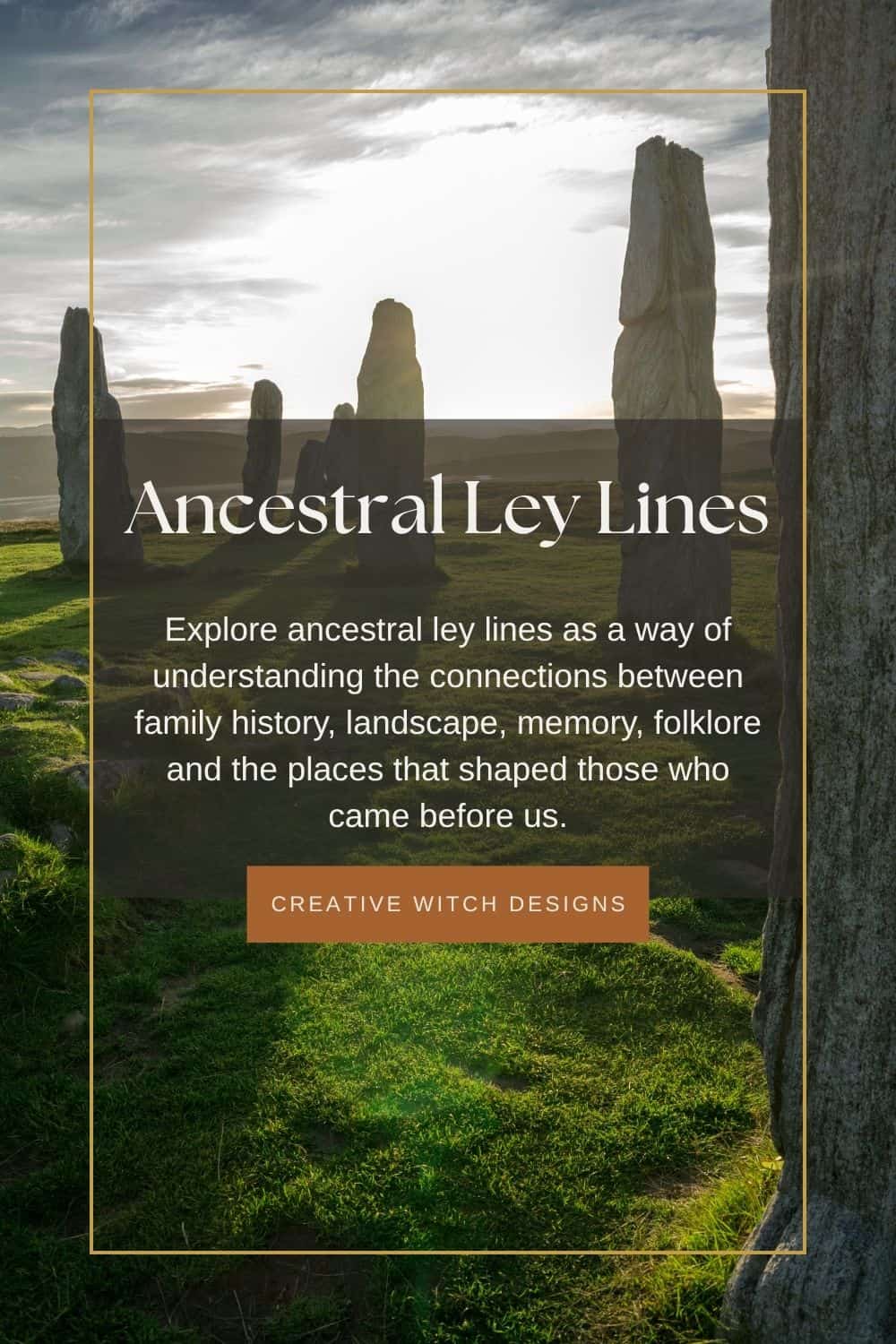
Ley lines have long captured the imagination.
The idea that ancient monuments, sacred sites and important landmarks might form meaningful alignments across the landscape has become part of modern folklore, earth mysteries and contemporary spiritual practice. Whether understood literally, symbolically or simply as a way of noticing patterns in the land, ley lines speak to something humans have always done: connect place with story.
We remember where things happened.
We mark burial places.
We return to wells, trees, crossroads and hills.
We attach meaning to the landscapes that hold our memories.
That same idea can be extended inward.
What if our families also have their own invisible lines of connection? Not energetic highways in a scientific sense, but threads of memory, habit, story, place and repetition that run through generations.
I think of these as ancestral ley lines.
They are the routes our families travelled, the places they returned to, the stories that kept being told, the customs that survived and the patterns that continued long after anyone remembered where they began.
What do I mean by ancestral ley lines?
Ancestral ley lines are not something you can map with certainty. I use the phrase as a metaphor. Just as ley lines are imagined as connections between significant places, ancestral ley lines can describe the connections between people, landscapes, stories and inherited ways of living.
They might appear through a family that remains tied to the same village for generations.
Through a recipe made by mothers and daughters without anyone remembering who first created it.
Through a profession that keeps appearing in the family tree.
Through recurring migration routes.
Through a house, farm, church or coastline that carries meaning long after the original people are gone.
These threads are not necessarily mystical.
Sometimes they are simply the way history continues to echo.
The connection between ancestry and place
One of the most interesting things about family history is how often place matters.
Names on a family tree can feel abstract until you find the village where those people lived.
Then something shifts.
Suddenly there are roads.
Churchyards.
Fields.
Rivers.
Buildings.
Distances people would have walked.
Places where children were born and people were buried.
A landscape turns genealogy into something tangible.
This is where the idea of ancestral ley lines becomes especially compelling.
You begin to see that ancestry is not only about people.
It is also about geography.
A family story may be rooted as deeply in a particular landscape as it is in a surname.
Places can carry memory
Humans have always associated certain places with memory.
A childhood home can carry an emotional weight long after you have moved away.
A cemetery can feel different because we understand what it represents.
A street where a family lived for generations can become meaningful even to descendants who never lived there themselves.
That does not require us to believe the land is literally storing emotion.
The meaning exists because human beings create relationships with place.
Stories accumulate.
Events become attached to locations.
Names survive on maps.
Buildings disappear while memories remain.
Over time, landscape becomes part of family identity.
The stories families repeat
Ancestral lines are also carried through stories. Some are told openly. Others appear only in fragments.
A grandmother mentions a place but never explains why it mattered.
An old photograph has names written on the back.
A family saying is repeated for decades even though nobody knows where it came from.
Certain subjects are talked about constantly while others remain strangely absent.
These gaps can be just as interesting as the stories themselves.
When we begin researching family history, we often discover that what we thought was “just how our family is” has a context.
Perhaps a family valued stability because several generations had experienced displacement.
Perhaps thrift was shaped by poverty.
Perhaps a particular trade continued because children learned skills from parents.
That is not supernatural inheritance.
It is culture moving through generations.
When patterns feel ancestral
Family patterns can sometimes feel strangely repetitive. The same careers appear. People marry young. Families move away and return. Names repeat. Certain attitudes towards money, work, marriage or education seem to persist.
It is tempting to describe these patterns as ancestral energy, but often there are understandable historical and social explanations.
People inherit circumstances as well as stories.
They inherit expectations.
Opportunities.
Values.
Connections.
Ways of speaking.
Ideas about what is possible.
Those influences can travel surprisingly far through a family line.
Looking at them with curiosity can help us understand where our own assumptions may have come from.
Ancestral ley lines as a research practice
One of the most interesting ways to work with this idea is to make it literal.
Start mapping your family.
Not only names and dates.
Places.
Where were people born?
Where did they marry?
Where did they die?
Which towns, villages or counties keep appearing?
Where did people move from and where did they go?
Once those locations are visible on a map, patterns often emerge.
Perhaps several generations lived within a remarkably small radius.
Perhaps one branch moved repeatedly along a particular industrial route.
Perhaps another followed military postings, agricultural work or coastal trade.
These movements can tell you a great deal about how your family lived.
Follow the landscape, not just the family tree
Traditional genealogy often focuses heavily on records.
Birth certificates.
Marriage records.
Census returns.
Parish registers.
But the landscape can add another layer.
Look at old maps.
Research the industries of the area.
Find out which churches, schools, factories or estates existed at the time.
Learn what the land was used for.
Was the area agricultural?
Industrial?
Coastal?
Mining?
Military?
Urban?
Rural?
A family member who appears only as a name on a census suddenly becomes easier to imagine when you understand the world around them.
Visit ancestral places when you can
If you know where family members lived, visiting those places can be surprisingly moving. You do not need to expect a mystical experience. Simply walk. Look. Notice the distance between places. Stand outside the church. Find the street. Walk through the cemetery. Look at the land.
Try to imagine what would have been familiar to someone living there a hundred years ago.
Some things will have disappeared. Others may remain almost unchanged.
That contrast can create a much stronger sense of connection than a family tree alone.
Create your own ancestral map
You could turn this research into something visual. Create a map showing the important places in your family history.
Add names.
Dates.
Photographs.
Migration routes.
Occupations.
Stories.
You might discover clusters where several generations lived close together, or lines showing movement from one region to another.
This becomes your own version of an ancestral ley line map. Not a map of invisible energy, but of movement, memory and continuity.
Objects can become part of the line too
Ancestral connection does not only exist in places. Objects can carry family history as well. A ring. A recipe book. A photograph. A tool. A letter. A piece of furniture. A sewing box.
The object itself may be ordinary, but its meaning comes from the story attached to it. These objects create another kind of line through time.
Somebody used this. Somebody held it. Somebody decided it was worth keeping. Eventually it reached you.
That continuity can be powerful without needing to be supernatural.
Folklore can reveal another layer of ancestry
Family history becomes even richer when it intersects with local folklore.
What stories were told in the area where your ancestors lived?
Were there sacred wells nearby?
Ancient trees?
Ghost stories?
Seasonal customs?
Local superstitions?
Pilgrimage routes?
Old fairs?
These stories would have formed part of the cultural landscape around the people who lived there, even if we cannot prove whether a particular ancestor believed them.
Exploring that folklore helps us understand the imaginative world surrounding a place.
It gives us more than facts. It gives us atmosphere.
Be careful not to romanticise the past
Ancestral research can easily drift into romantic storytelling. It is tempting to imagine every ancestor as deeply connected to land, ritual and seasonal wisdom.
Reality was usually more complicated. People worked hard. Families argued. Traditions changed. Knowledge was lost. Communities were shaped by class, religion, poverty, migration, war and social expectations.
Some ancestors may have loved where they lived. Others may have desperately wanted to leave.
Respecting ancestry means allowing the past to remain complicated. We do not need to turn every family story into a sacred lineage in order for it to matter.
Create a simple ancestral place ritual
If you enjoy ritual, you can use it as a way of marking connection rather than trying to change or heal the past.
Choose a place connected with your family if you have one.
It might be a village, churchyard, beach, street, woodland or even somewhere represented only through a photograph or map.
Bring a notebook.
Spend some time observing the place.
Write down what you know.
What happened here?
Who lived here?
What would they have seen?
What has changed?
What remains?
You might light a candle later at home or place a photograph beside a map and simply acknowledge the connection.
The ritual is remembrance.
Nothing more is required.
Questions to explore
If you want to investigate your own ancestral ley lines, you might ask:
Which places appear repeatedly in my family history?
Where did people move from and why?
Which professions or skills travelled through generations?
What family stories are connected with particular places?
Which traditions survived?
Which disappeared?
What local folklore surrounded the places my family lived?
Are there objects, recipes or sayings that act like threads between generations?
What assumptions about family history have I inherited without ever checking them?
These questions can open up far more interesting research than simply asking what “ancestral energy” you are carrying.
The lines between past and present
Perhaps ancestral ley lines are best understood as the routes through which memory survives. Some are geographical. Some are cultural. Some exist in stories. Some in objects. Some in habits we barely notice. Some disappear completely until a document, photograph or place brings them back into view.
We may never know every story. There will always be gaps. Names without photographs. Places we cannot locate. Events nobody recorded. But those gaps are part of ancestry too.
We do not need to fill every silence with certainty. Sometimes the work is simply to follow the threads that remain.
We are part of the line too
Ancestral research often focuses on looking backwards. But we are not standing outside the family story. We are inside it.
The things we keep, record, photograph, cook and talk about may become somebody else’s family history one day. The stories we preserve may travel further than we imagine. The places we love may become meaningful to people we will never meet.
Seen that way, ancestral ley lines are not only about where we came from. They are also about what we choose to carry forward.
The line does not end with us. It continues.