
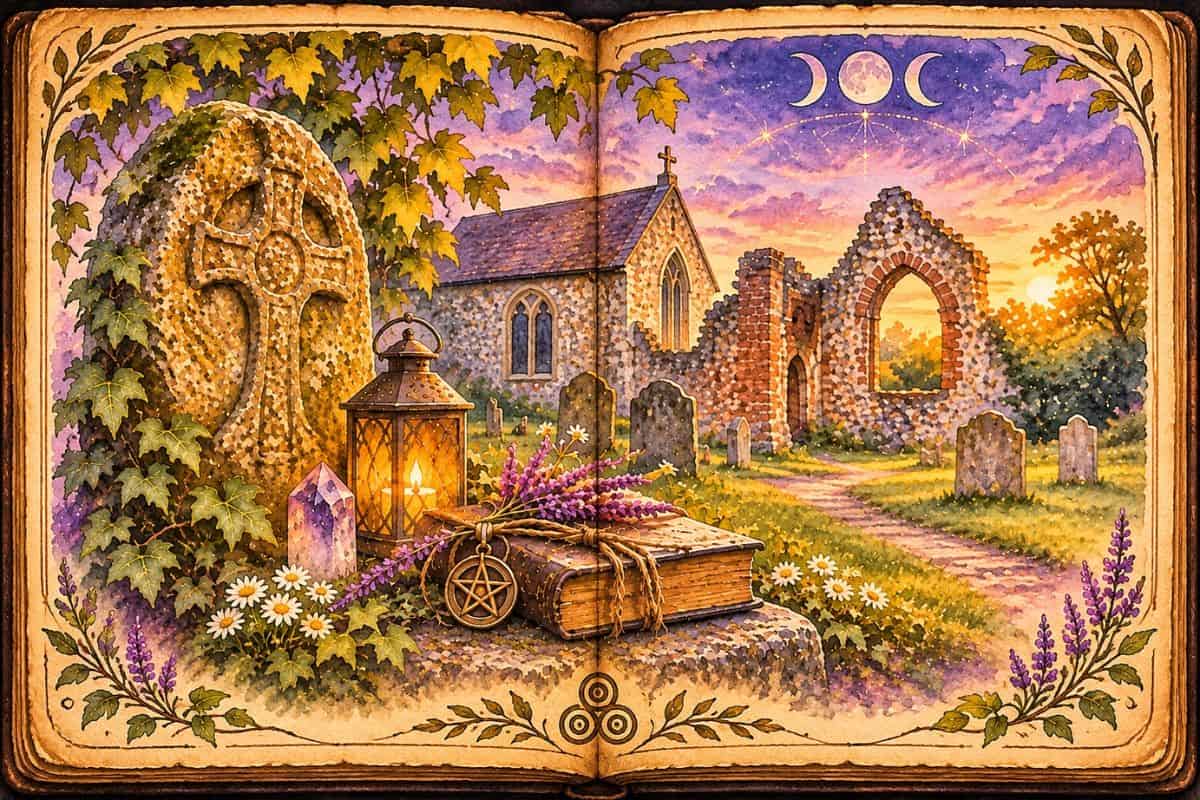
Warblington has always felt different from other historical places around Havant because so much of its story is compressed into such a small area. The church, graveyard, old yews, surviving castle gateway and surrounding fields sit within walking distance of one another, yet each belongs to a different chapter of the past. What fascinates me most is not simply that these things are old, but that they create a very particular atmosphere when experienced together. This is a place where devotion, burial, politics and everyday village life have overlapped for centuries, and that makes it especially interesting to me as someone who is drawn to the relationship between history, folklore and sacred practice.
As a witch, I am naturally curious about places where boundaries feel thin, not because I believe every churchyard or ruin must be supernatural, but because these are places where human beings have invested enormous emotional meaning. People have worshipped here, buried their dead here, walked pilgrimage routes here and watched powerful families rise and fall nearby. That gives Warblington a different energy from Staunton. Staunton speaks to me through trees, cultivation and changing landscapes, while Warblington speaks through mortality, devotion, ritual and the way human beings try to make meaning out of impermanence.
A church carrying more than one age
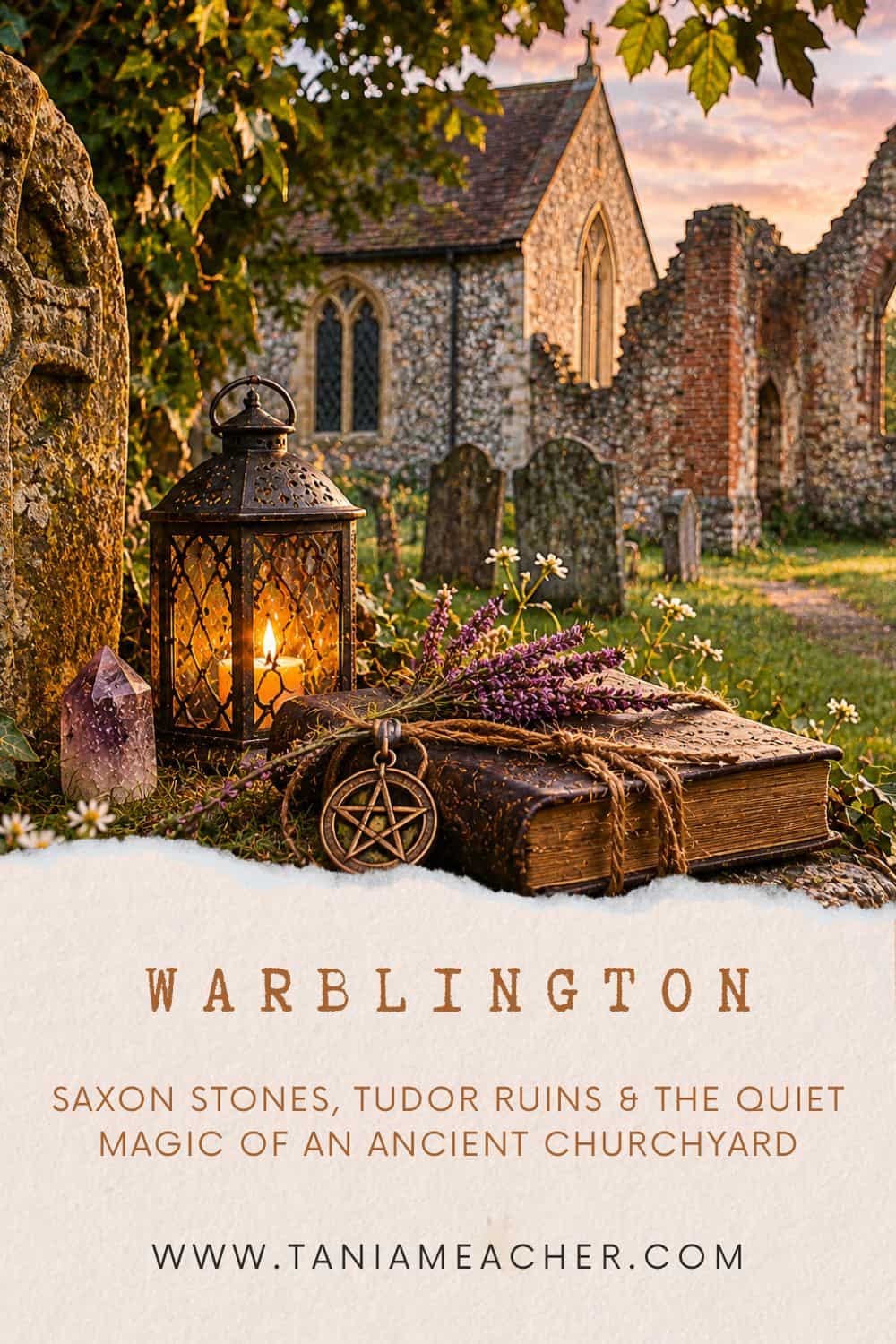
The Church of St Thomas à Becket contains surviving Saxon fabric, including its central tower, while other parts of the building were added or rebuilt during later medieval centuries. Historic England records that the church developed through several phases, with substantial work taking place from the late twelfth century onwards.
I find buildings like this far more interesting than structures that belong neatly to one period, because Warblington Church carries centuries within the same walls. One generation built, another altered, another repaired, and another simply continued using what had already been handed down. That continuity matters because sacred spaces rarely remain unchanged. They evolve alongside the communities that use them, absorbing different customs, architectural styles and ways of worship while still retaining something recognisable at their core.
There is something particularly moving about knowing that the church is still in use today. It has not become an abandoned monument preserved only for visitors. People still gather there for worship, funerals and remembrance, which means the building continues to fulfil the purpose for which it has existed for centuries. For me, that living continuity is far more powerful than treating the church as a frozen piece of history.
Pilgrimage and the meaning of walking with purpose
Warblington is also connected with the Old Way, an old pilgrimage route associated with journeys towards Canterbury and the shrine of Thomas Becket. The parish identifies the route through the churchyard as part of this long tradition of pilgrimage.
Pilgrimage interests me because it turns movement into intention. A journey becomes different when you are not simply travelling from one place to another, but walking for a reason that carries emotional or spiritual weight. The feet still move in exactly the same way, yet the meaning of the journey changes because the traveller has chosen to make the route significant.
That principle exists far beyond Christianity. Sacred journeys appear in many cultures and traditions, whether people are travelling to wells, shrines, mountains, burial sites or other places considered spiritually meaningful. The act of walking creates rhythm, repetition and space for thought, and that is something I can relate to deeply through my own witchcraft. There is something transformative about moving slowly through a landscape while holding a question, an intention or a memory.
Knowing that pilgrims once passed through Warblington changes the way I see the churchyard path. It becomes more than a convenient route between one gate and another. It becomes part of an older tradition of movement shaped by devotion.
The old yews and the symbolism of endurance
Warblington churchyard contains several mature yew trees, which are noted in Havant Borough Council’s landscape assessment alongside the flint church, burial ground and surviving gravewatchers’ huts.
Yews have one of the strongest symbolic associations of any tree in Britain. Their extraordinary longevity, evergreen foliage and frequent presence within churchyards have linked them with death, endurance and renewal for centuries. They also appear repeatedly in folklore and funerary symbolism, which makes them impossible to ignore when walking through an old burial ground.
What interests me most about the yew is the tension between death and persistence. It grows among graves, yet remains green through winter. Its presence does not deny death, but it offers an image of continuation alongside it. That symbolism feels almost inevitable when the tree is encountered within a churchyard, especially somewhere like Warblington where generations of burial and remembrance are physically visible.
I do not think we need to make exaggerated claims about every old yew marking a pre-Christian sacred site, because that often moves beyond what the evidence can support. The tree is already powerful without needing a more dramatic story. Its age, appearance and association with burial create enough symbolism on their own.
A churchyard full of human stories
The churchyard itself is one of the most evocative parts of Warblington. The older burial ground eventually closed to new burials, while the adjacent cemetery continued the tradition of laying local people to rest in the same area. Parish information describes the churchyard as containing more than sixty trees, historic gravestones and lichens growing over undisturbed stone.
I have always found graveyards strangely compelling because they make human relationships visible in a way that few other places do. A gravestone might record a husband and wife, a child, a sibling or several generations of one family, and suddenly history becomes intimate rather than abstract. Dates on a page can feel distant, but dates carved into stone carry a different weight because they belong to somebody who once had a home, relationships and a place within a community.
This is one reason graveyards matter within ancestral and spiritual work. They remind us that history is not only about kings, battles and buildings. It is also made up of ordinary lives, losses, marriages, births and family connections. Even when I do not know the people whose names I am reading, I am aware that those names represent complete lives rather than historical decoration.
The gravewatchers and fear of the body snatchers
Warblington’s surviving gravewatchers’ huts add a much darker and more unusual chapter to the churchyard story. These small structures were used by men who guarded newly buried graves during a period when body snatching had become a genuine concern. Fresh corpses could be stolen and sold for anatomical study, leaving grieving families fearful that burial did not necessarily mean their loved ones would remain undisturbed.
This is the kind of history that sounds almost like gothic fiction until you remember that it was part of real life. Families were already experiencing grief, yet they also had to worry about the physical safety of the dead. The gravewatchers therefore became protectors of a boundary that most people assumed should never be crossed.
I find that deeply significant from a witchcraft perspective because the treatment of the dead has always carried ritual importance. Human beings create rules around burial, mourning and remembrance because death changes the relationship between the living and the body. Washing, shrouding, burying, guarding and marking the grave are all ways of creating structure around something that is emotionally overwhelming.
The gravewatchers of Warblington were performing a practical task, but the symbolism is still powerful. They were protecting the boundary between the living world and the resting dead.
Warblington Castle and a ruined world of Tudor power
Close to the church stands the surviving gateway tower of Warblington Castle. Historic England describes it as part of a large Tudor courtyard house built for Margaret Pole, Countess of Salisbury, between approximately 1514 and 1526. Much of the house was destroyed during the Civil War in 1643, leaving only fragments of what had once been a substantial and prestigious residence.
The surviving gateway is striking precisely because so much else is missing. It is difficult to stand near a ruin like this without mentally reconstructing the buildings that once surrounded it. Rooms, courtyards, servants, visitors and domestic life have vanished, but a single piece of architecture remains to show that something important once stood there.
That absence makes the castle particularly evocative. Complete buildings explain themselves more easily because you can see their form and purpose, while ruins demand imagination. They make you think about what has been lost, why it disappeared and how something once considered permanent can become almost invisible.
Margaret Pole and the danger of Tudor politics
The castle’s association with Margaret Pole makes the site even more compelling. She was one of the most prominent noblewomen of Tudor England and had close connections to the royal family through the Plantagenet line. Her life eventually became entangled with the dangerous politics of Henry VIII’s reign, and she was executed in 1541 after falling from royal favour.
Warblington Castle therefore belonged to a world in which family lineage could bring extraordinary privilege and extraordinary danger. Status did not guarantee safety, and proximity to power could be as dangerous as it was advantageous.
That knowledge changes the way I see the ruins. They become more than picturesque Tudor remains. They belong to the life of a woman who occupied a complicated position within one of the most volatile periods of English history.
As someone deeply interested in ancestry, I find stories like Margaret Pole’s especially compelling because they reveal how inheritance can shape a life in ways that go far beyond money or property. Family identity, political allegiance, religion and ancestry were inseparable within the Tudor world, and those inherited connections could determine opportunities as well as dangers.
What ruins teach about permanence
Ruins create a particular kind of honesty because they make impermanence visible. Warblington Castle once represented wealth, status and security, yet most of it disappeared within little more than a century of being built. The surviving gateway reminds us that even structures created to project permanence can become fragments.
I find that idea spiritually useful because it challenges the illusion that anything human remains fixed. Buildings disappear, political systems change and reputations shift over time. What seems enormous in one century may survive only as a broken wall in another.
That does not make human effort meaningless. It simply places it in perspective.
For me, this is where ruins become contemplative spaces. They invite questions about what we build, what survives and what ultimately matters when the visible structure has gone.
Where the church and castle almost meet
One of the most interesting things about Warblington is how closely religious and political histories sit beside one another. The church represents continuity, worship and community life, while the castle represents wealth, status and political power. One remained in active use while the other largely disappeared.
That contrast is striking.
The castle belonged to a powerful family, yet the church continued long after the household had gone. The grand residence became a ruin, while the quieter building used by generations of local people remained part of everyday life.
There is something almost symbolic in that difference. Power often appears permanent while it is being exercised, yet ordinary community practices can survive for much longer.
Death, thresholds and witchcraft
Warblington speaks strongly to themes of thresholds because so much of the landscape sits between one state and another. The church connects everyday life with spiritual practice. The graveyard marks the boundary between the living and the dead. The pilgrimage route transforms ordinary walking into devotional movement, while the castle ruins hold the remains of something that exists somewhere between presence and absence.
These are the kinds of spaces that naturally interest me as a witch.
Thresholds appear constantly within magical traditions because transition creates uncertainty. Doorways, crossroads, shorelines, dusk, dawn, birth and death all represent moments when one condition is changing into another. Warblington contains several of those ideas within a very small area, which is one reason the place feels so rich symbolically.
That does not mean I need to declare the site supernaturally charged. The symbolism already exists within the history itself.
The sacred does not always need spectacle
What I appreciate most about Warblington is its restraint. The place does not rely on dramatic scenery or monumental ruins to create atmosphere. Its character comes from the relationship between smaller things, including the old church, the yews, the gravestones, the ruined gateway and the pathways running between them. The experience becomes richer when you know what you are looking at. A church tower becomes Saxon masonry rather than simply an old tower. A small hut becomes evidence of people once guarding graves against body snatchers. A ruined gateway becomes the surviving fragment of a Tudor household shaped by one of England’s most turbulent political periods.
Knowledge does not strip the magic from the place. It sharpens it. That is the kind of sacred landscape I am most interested in exploring.
Walking Warblington with intention
Warblington is a place worth walking slowly because its atmosphere is easy to miss when experienced in a hurry. The churchyard deserves time, particularly around the yews and older gravestones, while the castle ruins become more meaningful once you understand the scale of the house that once stood there.
I also like the idea of acknowledging the pilgrimage route while walking through the churchyard. You do not need to share the beliefs of the medieval pilgrims who travelled there to appreciate the significance of intentional movement. Simply knowing that generations of people passed through the same landscape with purpose changes the experience.
For me, that is where witchcraft becomes practical. It is not always about performing a ritual or looking for signs. Sometimes it is simply about being fully present in a place and understanding enough of its story to recognise what you are standing among.
A different kind of sacred landscape
Warblington feels sacred to me for very different reasons than Staunton.
Staunton draws me towards trees, cultivation and our relationship with the living landscape. Warblington turns my attention towards mortality, remembrance, devotion and impermanence. The old yews speak about endurance beside death. The gravewatchers remind us how fiercely people once protected the bodies of those they loved. The pilgrimage path carries a history of journeys made with spiritual intention, while the castle ruins show how quickly status and power can disappear.
Together, those things create a landscape that invites reflection rather than spectacle. That is what keeps drawing me back to places like this. History gives me the facts, folklore gives me another way of reading them, and witchcraft allows me to ask what those stories stir within me now.
Explore Havant’s hidden landscape
Warblington forms part of a wider landscape around Havant where Roman roads, springs, ancient churches, harbour routes, old estates and woodland all intersect. My starting point for this local series is Havant’s Hidden Landscape: Sacred Springs, Roman Roads & the Old Paths Beneath Our Feet, which explores how these different histories connect across the area.
Future articles will take us into Langstone, Rowlands Castle and Havant Thicket, each through a different historical and witchcraft lens rather than repeating the same story in a different location.